









|
Signature Sponsor


December 11, 2025 - Despite substantial energy policy and trade uncertainty, the outlook for much of the US Gulf Coast's energy economy is "cautiously optimistic," albeit less so than in 2024, the Louisiana State University Center for Energy Studies said Dec. 10. "One of the central themes in the stakeholder calls this year was policy uncertainty," said Greg Upton, executive director of the center, during a webinar about its Gulf Coast Energy Outlook, which focuses on Alabama, Louisiana, Mississippi and Texas. He cited the Republican Party's "unprecedented" repeal of renewable energy tax credits before a previous law's expiration and the Trump administration's unilateral levy of tariffs on international trade partners. "So, one of the discussions happening is, are we going to start seeing, when new administrations come in, this back and forth?" Upton said. "And how does that impact investments that persist a long time?" However, the region's crude oil and natural gas production are likely to continue growing, while "decarbonization initiatives, supported by federal subsidies ... offer both opportunities and risks for regional energy manufacturers, especially as global demand for lower-emission products grows," the center said in its GCEO report. "Additionally, electricity's increasing share of energy use and industrial expansion in the Gulf Coast are anticipated to sustain the region's competitive edge," the LSU center said. As an example of policy shifts, US Representative Garrett Graves, a Louisiana Republican, said during the webinar, "We've gone from an Obama administration energy policy to a Trump administration energy policy to a Biden administration energy policy and back to a second Trump administration." Upton cited the Biden administration's pause of new offshore oil and gas leasing in 2021 and subsequent cancelations of certain lease auctions, but the Trump administration subsequently advanced such plans, and a Gulf Coast oil and gas lease auction is scheduled for Dec. 10. Trump actions 'unprecedented'Also, the Biden administration's Inflation Reduction Act advanced renewable energy tax credits and incentivized offshore wind projects, while the Trump administration froze new and existing federal approvals of offshore wind projects. The Trump administration's One Big Beautiful Bill Act canceled certain renewable energy tax credits prematurely, Upton said, which was "really unprecedented." LSU's GCEO report assumes current policy persists, but considers how such uncertainty might affect investments, Upton said. Regarding trade issues, Upton said. "Right now, of course, we're waiting for the Supreme Court decision to see, well, does the executive branch have the authority to put in these tariffs without the action of Congress?" In the short term, multinational corporations seek ways to avoid tariffs by shifting production toward consumption locations, but in the longer term, the uncertainty can affect where capital is deployed. Slower growth foreseen So, the latest GCEO foresees growth that is not as optimistic as in previous projections. For example, Gulf Coast gas production in 2022 was forecast to exceed 60 Bcf/d in 2026, which is now projected to be delayed until 2028. After a first-quarter 2025 decline in gross domestic product, growth has resumed at a "robust" pace, Upton said, citing the US Bureau of Economic Analysis. "So, for our outlook, we're going to assume again that the economic outlook is strong," he said. "And so we can see this translating into world final energy consumption." In contrast with robust global energy demand growth, the US Energy Information Administration has seen flat total energy demand across the nation since the end of the 2008-09 recession, in terms of Btus, but the Gulf Coast's share is trending upward, said Andrew Owens, an LSU CES research fellow. "Looking at industrial sales, again, over the time frame, 30-plus years, sales are flat, but that doesn't tell the full story," Owens said. "If you look at a depiction of the Gulf Coast share, you see significant growth from around 16 to 17% 15 years ago to closer to 25% today." Industrial energy sales have grown in states such as Louisiana and Texas with strong natural gas and energy infrastructure, Owens said. Data centers at issue "There is an emerging story, though, and that is data centers," Owens said. "Over the last two years with the emergence of artificial intelligence hyperscale cloud operations, you have seen massive new data centers being proposed and constructed." Such individual data center projects have grown from 50 to 100 MW to gigawatt-scale efforts, Owens said. In Louisiana, for example, "the Meta Hyperion data center campus in Richland Parish in the northern part of the state that is being constructed is a 4 million-plus square feet facility and requires more than 2,000 megawatts of power," Owens said. "That's unprecedented. And, at least according to the Louisiana Economic Development Agency, there are some additional hyperscale data center facilities that are being considered for Louisiana." Graves, the Louisiana House representative, cited projections of "hundreds of billions of dollars" invested in "these data centers located in places that have abundant energy, that have the ability to put electricity in places where you can maintain reliability and price affordability, which means that Louisiana is going to be an attractive source." The Trump administration made AI "a high priority looking at this sort of like a cold war between the United States and China and that there will not be a second place," Graves said. Shifting generation stack Another factor affecting the Gulf Coast Energy Outlook is the changing generation mix, Owens said, with coal's share falling from more than half of US power supply in the late 20th century to about 15% today. In contrast, carbon-free nuclear, hydro, wind and solar's supply has grown to supply almost 40% of US power.
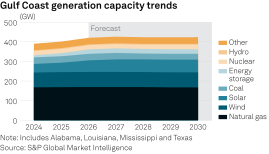
S&P Global Market Intelligence's power plant database shows the combined generation fleet in Alabama, Louisiana, Mississippi and Texas to top 423 GW of nameplate capacity by 2030 from about 390.1 GW in 2024. This would be led by almost 167.6 GW of gas-fired generation, 76.8 GW of wind and 64.4 GW of solar. Based on current retirement plans, the region's coal capacity is expected to fall to about 29.9 GW from more than 33.1 GW. |









|