









|
Signature Sponsor


February 9, 2026 - This report is part of the S&P Global Energy’s Metals Trade Review series, where we dig through datasets and digest some of the key trends in iron ore, metallurgical coal, copper, alumina, cobalt, lithium, nickel and steel and scrap. We also explore what the next few months could bring, from supply and demand shifts to new arbitrages and quality spread fluctuations.
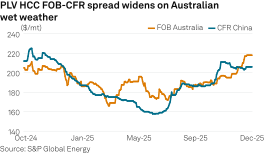
The Asian seaborne metallurgical coal market could ease in the rest of the first quarter of 2026 on stable Indian demand and a slowdown in China’s buying spree, despite starting the new year with elevated wet weather in Australia disrupting supply, market participants said. Asian seaborne metallurgical coal prices started Q1 on a firmer footing as heavy Queensland rainfall, force majeures and port/logistics disruptions tighten near-term spot availability through January and potentially into February. This coincided with traders’ expectations of India’s restocking needs, which have contributed to firmer prices since the fourth quarter of 2025 until Q1 so far. Prices of premium hard coking coal were mostly sideways through October and November, but began firming up by the end of December as supply-side wet-weather concerns added to market uncertainties. Platts’ Premium Low Vol Hard Coking Coal assessment ended the fourth quarter of 2025 at $218/mt FOB Australia Dec. 31, 2025, up $27.8/mt from the start of the quarter. The Platts PLV CFR China index increased $18.5/mt since the end of Q3 2025 to $205.5/mt Dec. 31, 2025, supported by firmer domestic coal supply fundamentals in China, and intermittent Chinese buying interest from portside arbitrage traders. A more moderate increase in the PLV CFR China index again widened the price gap with the FOB Australia benchmark, with the spread reaching minus $13/mt Dec. 31, a level last seen July 14, when Chinese seaborne demand rebounded, Platts data showed. China’s ability and willingness to pay up for seaborne cargoes were still hindered by weak Chinese steel margins and a softening market in December, driven by ailing prices in its domestic coke market, which saw three successive price reductions totaling Yuan 150-165/mt, market participants said.
Heavier-than-usual Australian rainfall a dominant factor
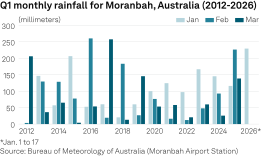
Australian coking coal supply conditions have moved to the forefront of the market’s focus since December, as miners adopted a more cautious stance toward spot sales amid early wet weather across key Queensland coal regions. Entering January, ex-tropical cyclone Koji brought widespread rain and flooding to mining operations in Australia’s northern and central Queensland, forcing several force majeure declarations from miners and port operations at the Dalrymple Bay Coal Terminalport. Fitzroy’s Carborough Downs mine, Stanmore’s South Walker Creek, Poitrel and Isaac Downs mine, and Pembroke’s Olive Downs, were some of those forced to issue selective force majeure on deliveries as supplies, logistics and mining were affected. “Australian supply has tightened in January due to weather-related force majeures and incidents, which may keep prices elevated in Q1,” according to CERA analysts at S&P Global Energy. While Australia’s rain- and cyclone-season-led supply disruptions historically support coking coal prices in Q1, the heavier-than-usual rains in 2026 have stoked market concerns. The Moranbah Airport station recorded 229.6 mm of rainfall as of Jan. 17, according to Australia’s Bureau of Meteorology, which had exceeded the total rainfall recorded in any January period since 2012.
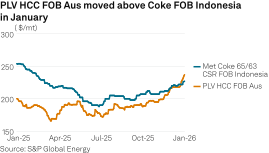
“Most [mines] are with water in the pits, you can only access the higher seams, which are generally the lower (coal) quality parts — so even as production comes back, we may see lower qualities of premium coals,” an affected Australian miner said. Moreover, with concerns over shipments and logistical backlogs, various regional trading sources expect the aftermath to drag further into February. The surge in coal prices has also worried end-users as steel and coke prices have lagged over the previous quarter, but a miner said the uptrend might be short-lived. “The rally will be a short-term one, and there will eventually be a cap for prices,” a second affected miner source said. “Mills’ margins are not improving. Though I think the downward correction may not come as hard as it did in the past due and will instead be supported by the expected slower recovery of shipments.” Separately, some regional buyers were hopeful that alternative supply origins could partially aid in the temporary dearth of Australian supplies. A Southeast Asian source said supply options were greater than in previous years due to the availability of Canadian coal, cargoes from China’s free-trade zones, and increased Indonesian coke supplies as alternatives. Focus on India’s coal demand which hinges on coke flows India’s Q1 met coal demand expectations largely hinged on the country’s pivot away from its 2025 coke import quota system to an antidumping duty regime that started in 2026. The quota system was put in place at the beginning of 2025 to protect domestic coke makers from more competitively priced imports. The antidumping duties on coke in 2026 target imports by origin, with a rate of $82.75/mt levied on Indonesian coke, the largest competition to India’s domestic market. Platts has observed five cargoes of Indonesian 65/63 CSR coke traded in Q4, compared with just one deal in Q3. Trading activity was heard to be in anticipation of the replacement of India’s import quota system, with cargoes observed to be priced between $203/mt and $220/mt FOB Indonesia, Platts data showed. “This [import quota in 2025] supported the local merchant coke market, and even for us, we began producing coke once again before our ovens were idled,” an Indian coke producer said, adding they doubt the new system will derail the local market as it adds to import costs. “But at the same time as international coal prices are increasing, this also prevents overseas coke suppliers from lowering their coke prices too.” Trading sources pointed to a wait-and-watch approach to India’s coke flows, as the market’s tilt toward either domestic or imported coke would indirectly determine India’s coal demand, and coal flows to Indonesia. “Merchant cokeries and small to mid-sized steel mills in India are likely to favor imported coke over coking coal, even after accounting for duties, given the wide price differentials,” an Indonesian coke supplier said.
|









|