






|
Signature Sponsor


April 4, 2026 - A new $850 million energy project in Mason County, West Virginia aims to redefine how coal is used, with developers saying it could transform one of the state’s most abundant resources into cleaner fuels, industrial materials and lower-emission energy.
Frontieras North America broke ground this week on its first commercial-scale facility using the company’s FASForm technology, a process designed to extract multiple products from coal and similar feedstocks rather than burning them for a single use.
The project positions itself at the intersection of traditional energy and advanced manufacturing, with company leaders and local officials pointing to its potential economic impact as well as its environmental claims.
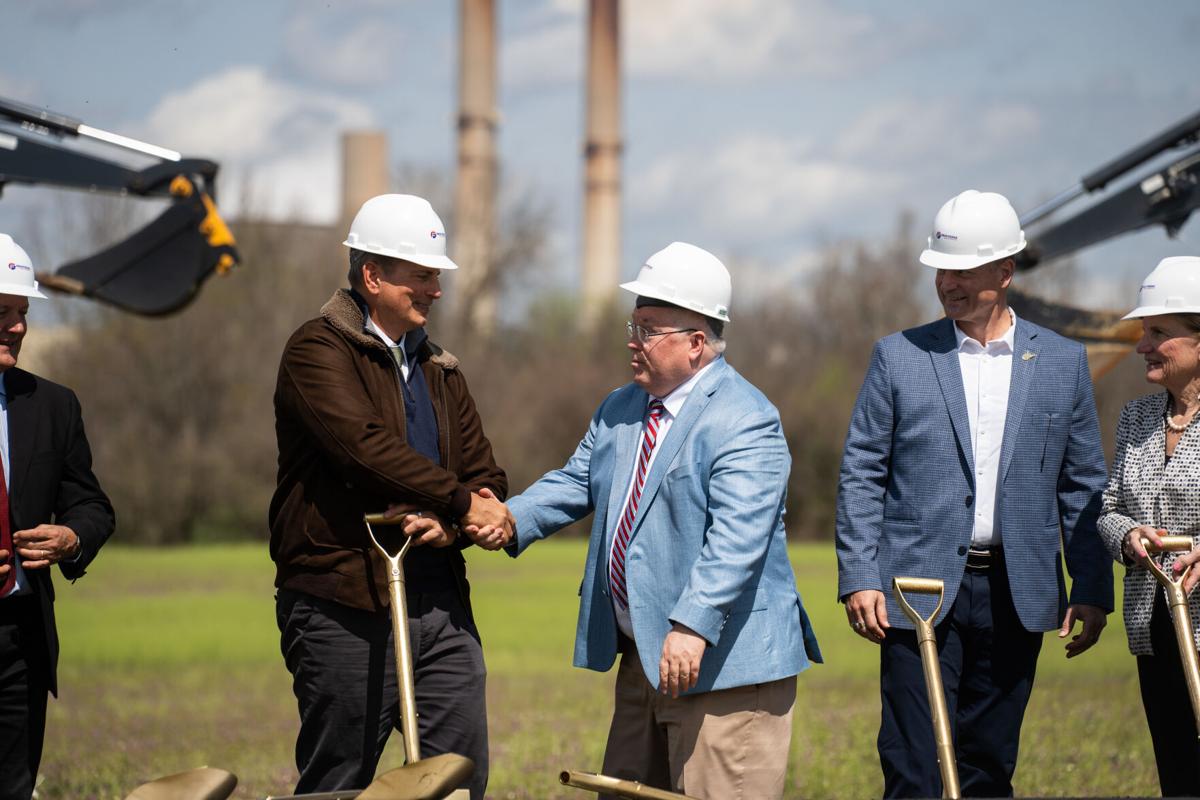
Matthew McKean, co-founder and CEO of Frontieras North America, left, shakes hands with Gov. Patrick Morrisey during a groundbreaking for the company’s Mason County facility.
Submitted photo
At the core of the facility is a refining system that company CEO Matthew McKean said fundamentally changes how fossil fuels are utilized.
“We can take the world’s most abundant energy sources — coal, lignite, which is a dirtier form of coal, and even oil sands — and run them through a refining process to extract gases and separate liquid products like jet fuel and diesel,” McKean said in a video explaining the technology. “What remains is a solid carbon product that can be used as a clean-burning thermal fuel to replace coal in power plants, reducing CO2 and sulfur emissions.”
McKean said the process also produces materials that could be used beyond energy generation.
“We also create a new product that can be used in industries such as steel manufacturing,” he said. “It is a nearly sulfur-free material that can be injected with iron ore to produce cleaner steel.”
The FASForm system uses a continuous thermal cracking and distillation process to break down solid hydrocarbons into their core components. According to the company, the technology produces gases such as hydrogen and methane, along with refined liquid fuels including diesel, jet fuel and naphtha.
Unlike traditional coal combustion, which releases emissions while generating a single stream of energy, the process is designed to separate and capture multiple outputs. The remaining solid carbon product — referred to by the company as FASCarbon — can be used as a cleaner-burning fuel or as an input for industrial applications.
Company officials say the system is designed to capture and repurpose byproducts, minimizing waste while creating additional usable materials. The facility is also expected to generate hydrogen on-site to help power its operations.
Supporters of the project, including industry groups, say the approach could reshape the role of coal in the energy economy by turning it into a feedstock for multiple products rather than a single-use fuel source.
The West Virginia Coal Association praised the development as a major step forward for the industry.
“What a pleasure it is to participate in this groundbreaking ceremony,” said Chris Hamilton, president and CEO of the West Virginia Coal Association. “We’re thrilled to welcome Frontieras to West Virginia and to see this incredible technology move from the research lab to commercial operation. This project is proof that coal’s future in our state is brighter than ever.”
Hamilton compared the process to a “coal-based version of a traditional gas cracker plant,” emphasizing its potential to diversify coal use beyond combustion.
When fully operational, the facility is expected to consume approximately 2.7 million tons of high-grade northern Appalachian coal annually, supporting an estimated 458 direct mining jobs and hundreds more throughout the economy.
“This single project represents more than $90 million in annual wages tied to coal supply and $5 million in severance taxes — a real win for West Virginia miners and our state economy,” Hamilton said. “Thanks to the leadership of President Trump, our congressional delegation and the Energy Dominance Council, the timing couldn’t be better for this kind of innovation and investment.”
Hamilton said the project could help “jump-start an entire universe of advanced coal and carbon products,” adding that, “with companies like Frontieras leading the way, we’re entering a new era — a true coal renaissance.”
The Mason County plant is expected to serve as a commercial model for future development, with company leaders indicating similar facilities could be built in other regions with access to coal and related resources.
State and local officials have pointed to the project as an example of how West Virginia’s energy industry could evolve, blending its long-standing reliance on fossil fuels with emerging technologies aimed at reducing environmental impact.
“From the very beginning, my partnership with Fronterias has been built on a fundamental truth: Coal is the bedrock of West Virginia and the backbone of American energy,” said Sen. Jim Justice, R-W.Va. “When I was governor, we laid the groundwork that has led us to where we are today. Now, in Mason County, we are seeing that vision take flight. Fronterias is a key player in strengthening our economy, creating jobs for our folks and continuing to move the needle on American energy independence. I’m especially proud of how far we’ve come, and I look forward to continuing to work with Fronterias for years to come.” |







|