






|
Signature Sponsor

May 21, 2026 - An attorney who represents workers is challenging lawmakers to urge the Mine Safety and Health Administration to restore its final rule on miner exposure to respirable crystalline silica.
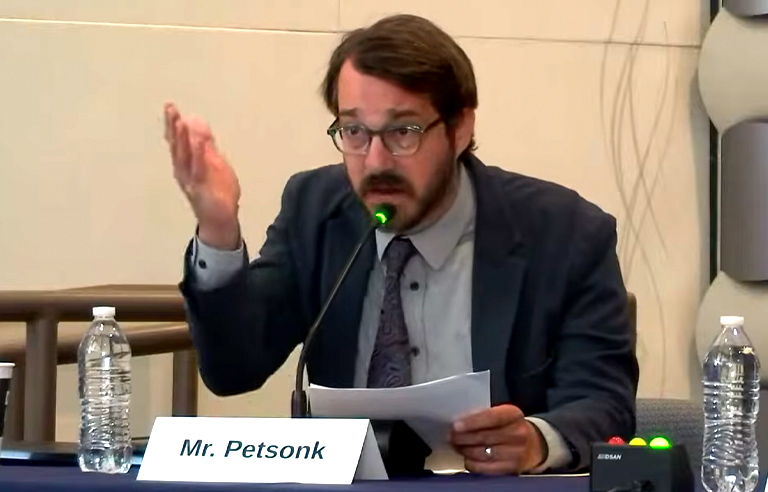
West Virginia-based attorney Sam Petsonk testified during a May 8 House Education and Workforce Committee field hearing at Vincennes University on the future of mining.
Petsonk called the rule a “long-overdue matter,” adding that “we have instituted a breathable silica limit for every other major category of American workers – except for the miners who face the most extreme exposures.”
Multiple studies show that cases of coal workers’ pneumoconiosis, or black lung – a deadly condition caused by exposure to respirable coal mine dust – are on the rise.
West Virginia-based attorney Sam Petsonk testified May 8 during a House Education and Workforce Committee field hearing at Vincennes University on the future of mining. Photo: House Education and Workforce Committee
MSHA published a final rule in April 2024 that reduced its permissible exposure limit for respirable crystalline silica to 50 micrograms per cubic meter of air over a time-weighted 8-hour shift. The new PEL is half the previous limit and matches the one OSHA established in 2016.
Enforcement of the rule, however, is delayed because of a lawsuit in the 8th U.S. Circuit Court of Appeals. In April, MSHA said it has delayed “indefinitely” the compliance deadline for metal and nonmetal miners after previously doing so for coal miners.
Five months earlier, the agency announced that it would “engage in limited rulemaking to reconsider” parts of the final rule.
On May 7, the Department of Labor sent to the White House Office of Management and Budget an information collection request on a revised silica proposed rule. Comments are due June 8.
In his opening statement, Rep. Tim Walberg (R-MI), who chairs the committee, discussed a July letter he and fellow House Republicans sent to MSHA calling on the agency to revise what the group called “overly burdensome” rulemaking.
“The mining industry depends on small and mid-sized operators, and several provisions in this final rule placed costly obligations on these businesses, which would likely cause them to close their doors,” Walberg said.
Petsonk addressed those remarks in his testimony.
“This is an urgent issue, and I respect the concerns about the industry and small operators very much,” he testified, “but my purpose here today is to say that the agency that is supposed to protect America’s miners has abandoned them in court.”
Petsonk contended that MSHA could have defended the rule amid the lawsuit and asked the appellate court to still “allow the rule to come into force to protect the most vulnerable” workers while working on revisions.
“This committee has an important opportunity to send a message to MSHA that you can protect miners, and you have a duty to do so under the [Mine Safety and Health Act of 1977],” Petsonk testified.
Walberg cited MSHA’s April announcement that the all-injury rate for the mining sector in 2025 was at a record low (1.74 per 200,000 hours worked).
“While there has been outstanding progress in keeping our workers safe, there is still more work to do,” he said. |










|