Colorado Summit: Mining Industry Needs to Build AI Tool to Cut Permitting Time

May 27, 2026 -
Summary
Metals and Minerals companies have been using artificial intelligence (AI) for several years to streamline processes, increase worker safety, lower costs and improve mining yields. The keynote speaker at last week's Western Mining Summit said it was time to build an AI tool to streamline and shorten the U.S. mining permit process.
Mining Permits Remain a Challenge in the U.S.
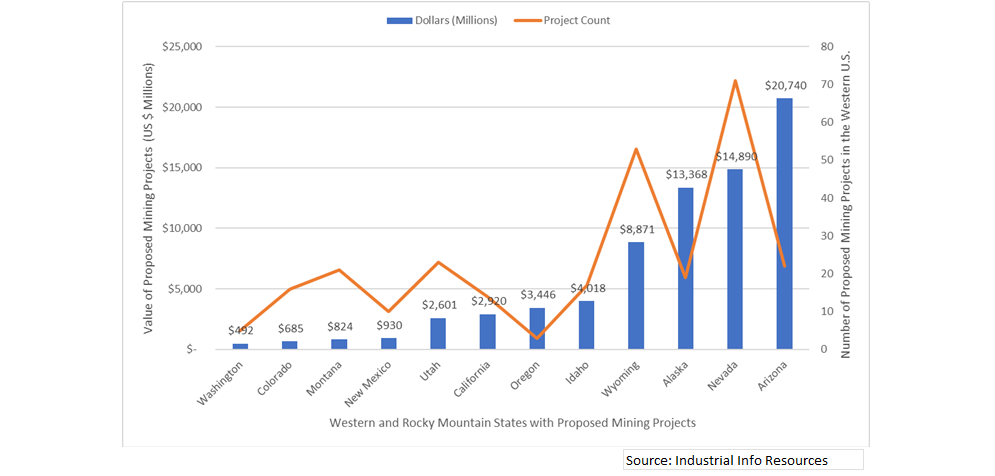
According to Industrial Info Resources data, 275 capital metals and minerals mining projects are scheduled to begin construction in the U.S. West Coast and Rocky Mountain regions between January 2025 and December 2028, with a total investment value of about US$74 billion. The states with the greatest amount of scheduled project activity include Arizona, Nevada and Alaska. Subscribers to the Industrial Info Resources Global Market Intelligence (GMI) Metals & Minerals Project Database can view a list of detailed project reports here.
Decrying the amount of time it takes mining companies to secure permits in the U.S., Red Conger, past president and chief operating officer of Freeport-McMoRan, last week told the Western Mining Summit in Denver, Colorado, that it was time to build an AI tool to expedite the permitting process for mines.
"It can take between 7 and 10 years, on average, for a mining company to secure a U.S. permit," Conger told about 300 attendees at the conference May 21. "The Resolution Copper Mine in Arizona has spent 13 years in pursuit of a permit."
The Western Mining Summit was sponsored by the Colorado Mining Association.
Among U.S. mining companies, he continued, operating costs have declined while production has increased. "But permitting has become more costly," the mining veteran said. "We need to collaborate differently with government" if the U.S. is to domestically source an adequate amount of critical minerals and rare earth elements it will need to propel its economy forward in the coming years.
"Permitting is easy to complain about but difficult to fix," said Conger, who has decades of operational and executive experience in the industry. "I'm not talking about ramming something through. Rather, it's time we produce a permitting process that we all can be proud of."
How AI Can Expedite Permitting
Conger told the event that mining permits are "a mountain of data" that try to assess the impacts of a proposed project on the air quality, water, land, cultural artifacts and more. But many documents filed as part of a permit application are not digitized. Digitizing those documents must be a top priority for mining companies, he urged. "We need to know with certainty what permit documents are digitized," he said. Once that is accomplished, leading companies in the industry, working with AI companies, could build an AI model specifically designed to inform government agencies as to the completeness of those documents and whether they incorporate global best practices, which could significantly reduce the time, cost and effort needed to secure a permit.
"I can get pretty excited about this," Conger told the attendees. "AI can access a permit's submission for compliance with state and federal laws and regulations, whether the proposed mine will incorporate industry best practices and so much more."
"Then, AI can be used to perform a deeper dive to identify if there are gaps or overlapping authorities in the permit documents," the mining veteran said, adding that deploying AI could make agencies "more comfortable that that are not overlooking, or duplicating, steps. The goal is to give regulators confidence that all necessary steps and analyses are covered."
By the Numbers
- 7-10 years: The average time it takes to secure a mining permit in the U.S.
- 13 years: The amount of time that Arizona's Resolution Copper Mine has spent seeking a permit
- US$74 billion: The value of proposed mining projects on the U.S. West Coast and Rocky Mountain regions that are scheduled to begin construction between January 2025 and December 2028
Calls for a Public-Private Partnership
Conger said he believes a "motivated" group could put together a public-private partnership (PPP) to build an AI mine-permitting tool. In the last few years, AI has made significant strides forward in various industries. Why should mining be any different?
"What would be needed, first, are far-sighted leaders who could contribute the financial and staff resources to digitize the data and built the model." Then, a period of experimentation needs to happen, to develop use cases and double-check the accuracy of the tool.
Successful PPPs, Conger told the conference attendees, "are built on trust, collaboration and ownership of the process and the results. Everybody needs to win. Everybody needs to improve. AI can help answer the question, 'How do we know?' "
But all participants need to come to the process with open minds: "Don't try to dominate the process or predetermine the outcome," he urged. Conger recalled that about a decade ago, when he was at Freeport-McMoRan, the company created a Technical Review Board when it was trying to permit a copper tailings facility in South America. The panel wanted to produce gold-standard science. "We funded (the panel), and the reports went straight to the government," he said. The company made no effort to influence the panel's findings.
The mining veteran said, "We got the permit faster, and the facility has operated smoother and safer and in a more beneficial environmental way" compared to peer facilities. "What we discovered there, through the creation of the Technical Review Board, has become a global best practice for tailings management."
"We have a great opportunity to create an AI tool to expedite mining permit applications," he concluded. Once the technical talent and financial resources are assembled, "we need to find a test case and get started."
Key Takeaways
- Extended mine-permitting processes in the U.S. may undermine the country's ability to secure adequate supplies of domestically sourced critical minerals and rare earth elements that are seen as vital to economic success in the coming years.
- Artificial intelligence (AI) could be used to shorten and streamline the state and federal permitting process for mines.
- A public-private partnership composed of mining companies and AI firms, possibly aided by financiers, could be assembled to build an AI tool specifically designed for improving the permitting process, according to a keynote speaker at the Western Mining Summit.
About Industrial Info Resources
Industrial Info Resources (IIR) is the leading provider of industrial market intelligence. Since 1983, IIR has provided comprehensive research, news and analysis on the industrial process, manufacturing and energy related industries. IIR's Global Market Intelligence (GMI) helps companies identify and pursue trends across multiple markets with access to real, qualified and validated plant and project opportunities. Across the world, Industrial Info Resources is tracking over 250,000 current and future projects worth $30.2 Trillion (USD).