
 








|
Signature Sponsor


June 4, 2026 - Coal stocks advanced Thursday, helped by news that President Donald Trump plans to provide about $700 million to the industry through a Korean War-era law that gives the federal government authority over sectors tied to national security. “As a result of the $700 million investment that I’m announcing today, we will protect 14 coal plants and 42 coal mines — it’s a tremendous number — and build two new coal plants and one massive new export terminal,” Trump said at an Oval Office event on Thursday afternoon. He said his administration’s action “will allow these facilities to invest in upgrades that will extend their operational lives for decades into the future, reinforce the reliability of our electric grid — which is really the biggest beneficiary — and most importantly, keep electricity prices very low for the American people.” Trump is aiming to deliver $425 million in Defense Production Act funds to 13 existing coal-fired power plants, along with $75 million in DPA money for an export terminal in Oakland, Calif., to ship out American coal. He also is seeking to provide $185 million in Energy Department grants to help build a coal plant in Alaska and another in West Virginia, as well as to restart one in western Maryland. The president’s plan was first reported by Bloomberg News and then was confirmed to MarketWatch by a White House official before the Oval Office event. An exchange-traded fund that tracks coal stocks, the Range Global Coal Index ETF COAL+2.07%, finished 2.3% higher Thursday, while the broad S&P 500 equity index SPX+0.41% advanced only 0.4%. Peabody Energy BTU+3.65% closed up 3.7%. Duke Energy DUK+0.64%, Hallador Energy HNRG+4.47% and American Electric Power AEP+1.17% are among the expected beneficiaries of the planned funding, according to Bloomberg’s report. Those companies’ shares rose between 0.7% and 4.5% on Thursday. Thursday’s move is the latest in a series of Trump administration actions that aim to revive the coal industry. In February, an executive order called for military bases to make electricity contracts with coal plants. Supporters say the revival is about meeting the demand for electricity, especially from the booming artificial-intelligence sector, and it’s about achieving energy security through domestic resources and reshoring manufacturing. Critics say it’s just postponing coal’s inevitable demise. 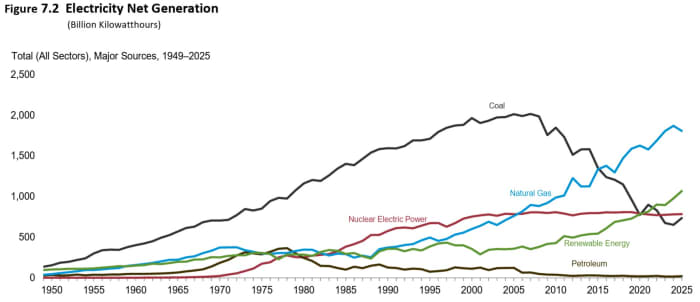 The U.S. Energy Information Administration expects coal to generate 16% of electricity in the U.S. this year and 15% in 2027, down from 17% in 2025. Natural gas keeps the lights on, for the most part, generating 40% of U.S. electricity last year, with a stable market share expected through 2027. Nuclear energy delivered 18% last year, while wind and solar were at 11% and 7%, respectively. An infusion of $700 million for the coal industry is “tiny compared to the billions it will cost to achieve everything,” said analysts at OPIS, an energy-data and analytics provider. For example, building a coal plant could cost more than $1 billion, but the Trump administration has allocated just $185 million across three projects. A new coal-export facility in Oakland would be meaningful as it would be the largest U.S. coal port on the Pacific, the OPIS analysts said, but $75 million covers only a small part of the expected cost. OPIS is part of Dow Jones, which also publishes MarketWatch. One environmental group, the Natural Resources Defense Council, blasted the Trump administration’s latest move with coal, saying in a statement Thursday that it’s “a stunning waste of taxpayer funds for a fuel that has been on decline for two decades.” “Because coal is uncompetitive economically, no new plant has been built since 2013, and coal’s share of electricity production dropped from more than half two decades ago to just 16% today,” the NRDC added. “What’s next, a taxpayer bailout to build new phone booths?” Trump has drawn scrutiny frequently over how his administration’s policies are benefiting his personal financial interests, including last month when he disclosed thousands of stock-market transactions. His latest disclosure showed three purchases of Duke Energy shares in this year’s first quarter, with one buy worth between $50,000 and $100,000. Duke relies much more on nuclear power and natural gas than coal, but it has said it’s extending its use of coal following changes in U.S. policy. A spokesperson for the Trump Organization has said the president’s investment accounts are independently managed by third parties using automated processes, and he has no role in selecting investments. Other uses of the Defense Production Act in recent years, include, during Trump’s first term, to force General Motors to make ventilators for COVID-19 patients, as well as during the Biden administration to accelerate domestic production of clean-energy technologies and increase supplies of baby formula amid a major shortage.
|









|