
 








|
Signature Sponsor


June 16, 2026 - Southeast Asia becomes one of the main engines of global energy demand growth under today’s policy settings. In the Stated Policies Scenario, the region contributes around 20% of the increase in global energy demand to 2035, supported by sustained economic expansion, rapid electrification and its growing role as a global manufacturing hub. Clean energy expands, but not fast enough to displace fossil fuels. In the STEPS, clean energy meets over 40% of incremental demand growth to 2035, while fossil fuels still meet around 60%. In the Current Policies Scenario, slower policy implementation, financing constraints and power system integration challenges prolong reliance on conventional fuels and push emissions higher.
Energy demand and CO2 emissions in Southeast Asia in the Stated Policies Scenario, 2015-2050.png) End-use energy demand continues to rise, but electrification and efficiency moderate growth in the STEPS. Total final consumption grows rapidly to 2035, by an annual average of 2.5% to 2035 in the STEPS. Industry remains the largest end-use sector, supported by expanding manufacturing and energy-intensive production. To 2035, Southeast Asia is one of the world’s fastest growing regions for aluminium iron and steel production, with output rising by 70%. This reinforces demand for electricity, coal and natural gas, while the young age of industrial assets limits near-term opportunities for fuel switching. In transport, electric vehicles and biofuels curb oil demand growth, avoiding around 1 mb/d of oil demand by 2035 together, reducing exposure to import price volatility and saving roughly USD 25 billion in oil imports, but road freight, aviation and petrochemical feedstocks keep oil use rising.
Electric vehicle stock in the STEPS, 2024-2050
.png) Buildings are a major source of electricity demand growth, led by cooling. Air conditioner stocks are set to triple by 2035 as incomes rise, cities expand and temperatures increase. Stronger minimum energy performance standards and better building codes could significantly reduce future cooling demand while improving affordability and resilience to heatwaves.
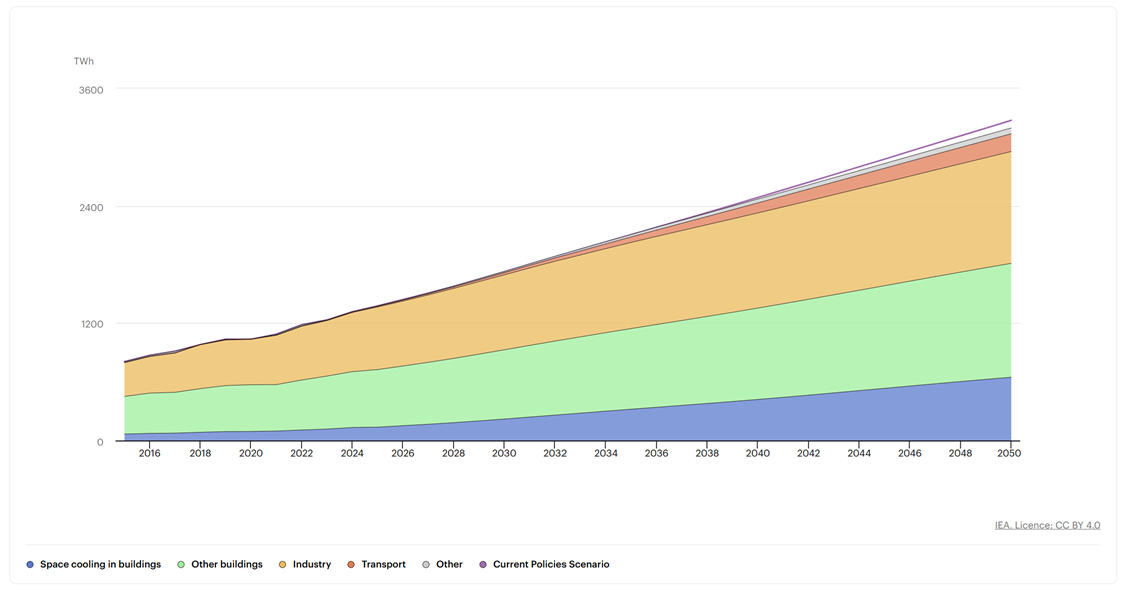
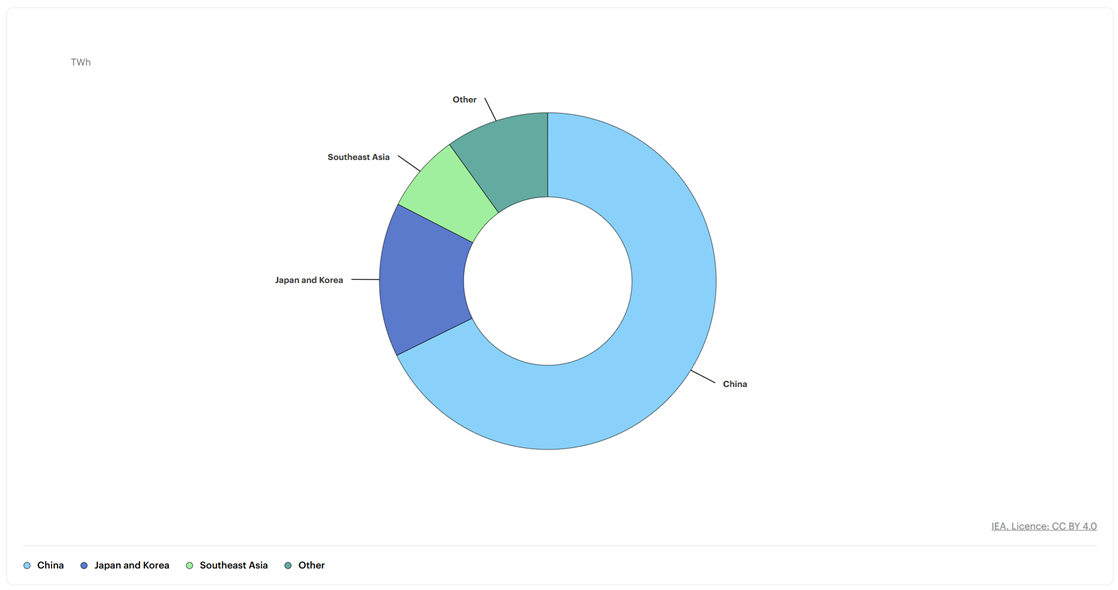
Electricity demand more than doubles to 2050, requiring a rapid expansion and modernisation of power systems. Growth is driven mainly by buildings and industry, while data centres add a new source of highly localised demand: Southeast Asia already accounts for around 10% of data centre electricity demand in the Asia Pacific region. Coal remains the largest single source of generation, but low-emissions sources gain ground, especially in the STEPS. Gas use in the power sector rises, with annual output increasing by more than 1.5-fold in both scenarios to around 600 TWh by 2035. In the STEPS, renewables and nuclear together provide just over half of total generation by 2050, compared with 43% in the CPS. Solar PV generation rises from 44 TWh in 2024 to almost 200 TWh in 2035 in the STEPS, while expansion is slower in the CPS due to integration challenges. Other renewables also increase, led by geothermal, mainly in Indonesia and the Philippines.
Electricity demand by end-use sector in Southeast Asia in the Stated Policies Scenario and the Current Policies Scenario, 2015-2050
 Data centre electricity consumption in Asia Pacific, 2024
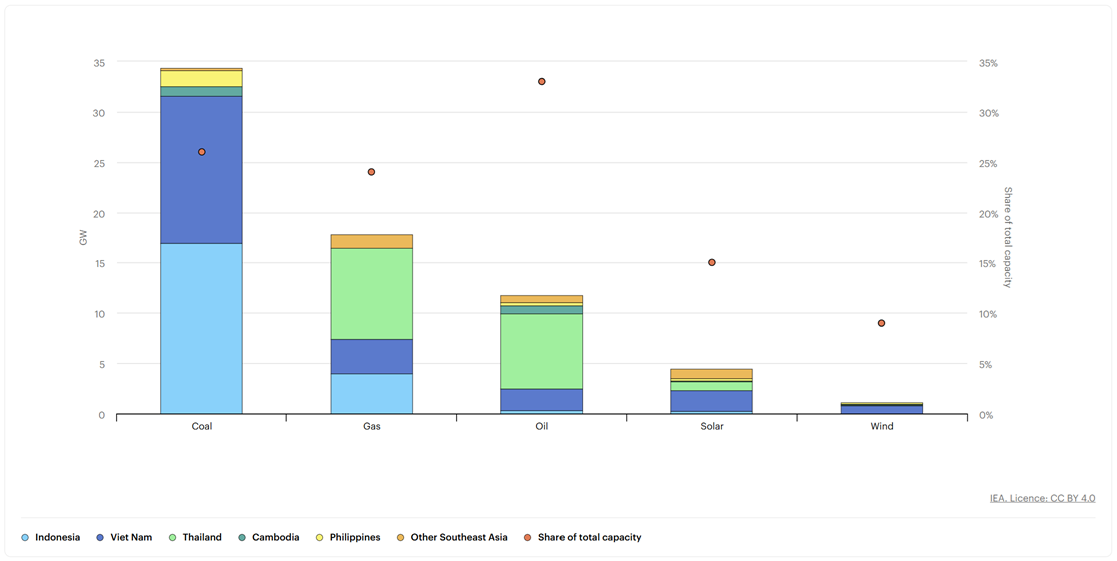
 Climate risks add another layer to the region’s power system challenge. More than 52 GW of thermal power capacity, along with nearly 4 GW of solar PV, is exposed to flood risks reaching at least one metre in depth. Climate change is expected to intensify heavy rainfall and expand floodplain exposure, increasing risks to power plants, grids and refineries. These risks can be avoided or minimised by implementing climate resilience measures, including stronger planning standards, better climate data and targeted investment in vulnerable assets. Generation capacity located in a river floodplain by country in Southeast Asia, 2025
 Oil demand continues to rise in both scenarios, widening the gap between regional consumption and domestic supply. Demand stands at around 5 mb/d in 2024 and rises in the STEPS to around 6.2 mb/d by 2035; in the CPS it reaches around 8 mb/d by 2050. Road transport remains the main driver, with diesel and gasoline use rising more slowly in the STEPS as electric vehicles and biofuels expand. Regional production remains constrained by mature fields, so net oil imports rise sharply, increasing exposure to fuel price volatility and disruptions at key chokepoints such as the Straits of Hormuz and Malacca.
Natural gas remains a central pillar of Southeast Asia’s energy system, but rising demand increasingly depends on LNG imports. In the STEPS, lower international gas prices support demand growth of more than 30% to 2035, driven by power generation, industry and petrochemicals. Gas-fired generation expands as a flexible and lower-emissions alternative to coal, balancing variable renewables while supporting electricity security. However, regional production falls as mature fields in Indonesia, Thailand, Malaysia and Myanmar decline, from around 210 bcm in 2024 to around 175 bcm by 2035 in the STEPS. This means Southeast Asia is set to become a net importer of gas in the coming year, increasing exposure to global LNG market risks.
Coal remains a mainstay of power generation, but the regional trade balance tightens over time. In the CPS, coal demand rises from around 340 Mtce in 2024 to roughly 460 Mtce in 2035 and continues to expand thereafter; in the STEPS, growth slows after the mid-2030s as alternative generation gains market share. Indonesia remains the dominant supplier, but rising domestic demand absorbs a larger share of production. As its exportable surplus narrows, Southeast Asia’s coal markets become more sensitive to supply disruptions, export restrictions and price volatility.
|









|