







|
Signature Sponsor


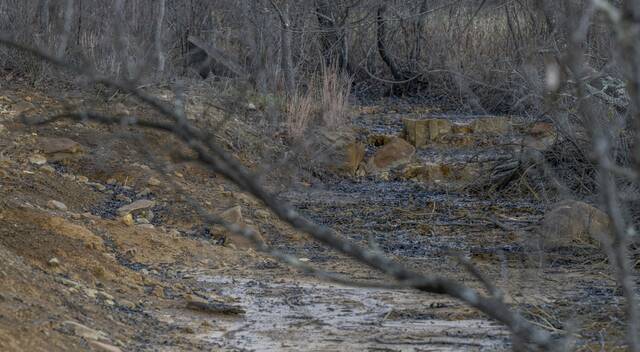
June 21, 2026 - An artificial mountain lies off a gravel road in Conemaugh Township, a rural community on the western edge of Indiana County. Ask a miner what the mass is made of, and they might say “boney” or “gob,” but its government name is a coal refuse disposal area.
The nearby Marion Mine ran from 1963 to 1994, employing almost 250 people at its peak. When electric utility PPL Corp. shuttered the operation, it left behind a 4 million-ton mound of low-quality coal and other material pulled from the ground.
Acidic compounds leach from the coal when it rains, escaping a thin layer of topsoil PPL placed to restore the land and searing a lifeless orange ring around the area. The runoff seeps into the ground, infiltrating local wells and the Conemaugh River about half a mile away.
It’s this toxic monument to environmental degradation where Bill Smith, owner of Wyoming-based startup Firepoint Energy, sees a potential pile of cash. About $1.2 billion in minerals essential to modern life, to be more exact, which he hopes to extract by heating the coal to extreme temperatures then filtering it through acids and liquid salts.
“My old man used to say to me, ‘One man’s trash is another man’s treasure,’ ” said Smith, clad in a flannel and barn jacket to keep out the cold November breeze during a tour of the site last fall.
He gestured toward the waste coal.
“And that’s treasure.”
A mound of coal refuse in Indiana County contains at least trace amounts of nearly 40 minerals vital to industry or national defense, including 16 of the 17 rare earth elements, says Bill Smith, who hopes to turn it into a cash bonanza through his company, Firepoint Energy. Photo: Louis B. Ruediger | TribLive
Powering the future
Chemical testing shows the pile contains at least trace amounts of nearly 40 minerals vital to industry or national defense, including 16 of the 17 rare earth elements.
These metals bear tongue-twisting names like praseodymium and ytterbium and are behind much of modern technology. Smartphones, missiles, MRI machines, electric vehicle batteries, aircraft engines — none of these would exist as we know them without rare earths.
They’re not actually rare, as the scientists who discovered them thought they might be, but they are hard to find in concentrations worth digging up. That makes the appeal of waste coal as a source of rare earths twofold: The coal is already out of the ground, and it contains a relatively high amount of rare earths.
Smith isn’t alone in seeing how the leftovers of Pennsylvania’s industrial past could give the state a greater role in powering the future. Several other companies and universities are working to extract large quantities of rare earths from acid mine drainage and coal ash produced by power plants.
If any of them are successful, they could help the country escape a real geopolitical bind.
China has mastered these finicky metals, gaining control over 60% of rare earths mining and 91% of processing, according to the International Energy Agency. That amounts to a monopoly, experts say, leaving the U.S. reliant on its chief adversary for essential manufacturing inputs.
A trade spat in October where China threatened to severely limit the export of critical minerals and rare earths put the precarity of the situation into stark relief.
The Trump administration has since moved to shore up supply chains, buying stakes in domestic rare earths companies and striking agreements with Australia and India, but the U.S. remains vulnerable in this arena.
“If China’s supply disappeared tomorrow, the U.S. and allies could eventually source many materials elsewhere,” said Julie Klinger, a professor of environmental studies at the University of Wisconsin-Madison. “Prices would undoubtedly rise sharply in the short term.”
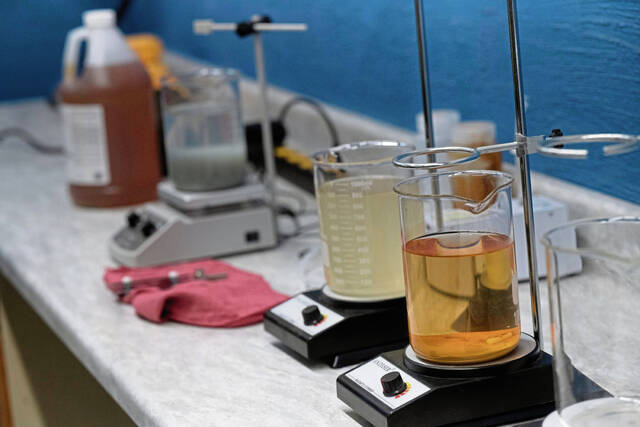
Water samples tainted by mine runoff inside a Firepoint Energy laboratory. PhotoL Louis B. Ruediger | TribLive
Extraction technology
Firepoint’s process starts by grinding the coal into powder. The dust is run through a machine that uses high heat to pull out what’s known as synthetic gas — the company plans to turn this into jet fuel — and leave behind a mineral-rich ash. The solid remnants are transferred to tanks with the acids and liquid salts that make the valuable metals inside pure and ready for sale.
Johnstown-based Concurrent Technologies Corp. has a narrower focus on separating the rare earths from one another. Many of these minerals are chemically similar and can be hard to pull apart. The company’s technology overcomes these issues by using the specific melting or boiling points of the various rare earths, according to Kevin Merichko, Concurrent’s director of infrastructure.
Penn State University’s Center for Critical Minerals has also gotten in on the action, pioneering methods to pull critical minerals and rare earths from acid mine runoff. The center’s on-campus pilot unit processes about seven gallons per minute from polluted streams.
The university is also involved in Expand Appalachia CORE-CM — short for carbon ore, rare earth and critical minerals — a regional initiative focused on identifying and analyzing deposits of these materials, including from secondary sources.
The payoff of these technologies and research efforts will come only if the resulting critical minerals and rare earths are priced competitively, noted Barbara Arnold, a professor of mining engineering at Penn State who is part of the Expand Appalachia project.
“You’re not going to do it unless you make a profit,” Arnold said.
Piles of piles
Smith claims the state is scattered with close to 10,000 piles of coal that is too energy-poor to be worth converting into power. Some contain up to 250 million tons of mining leftovers. At roughly 4 million tons, the Conemaugh one is a mere “baby pile,” he said.
The DEP counts over 1,000 waste coal piles abandoned before Aug. 3, 1977, when updated federal laws to promote reclamation of mined areas went into effect. The Firepoint site in Conemaugh’s Tunnelton section qualifies as a coal refuse disposal area, rather than a waste coal pile, because PPL Corp. left it behind after that cutoff.
Firepoint continues to scout additional sites in Pennsylvania, including in Wilkes-Barre and Tower City, Schuylkill County. The company has also entered an agreement with Penn State to pursue a U.S. Department of Energy grant for critical minerals and rare earths extraction and is working to go public.
The Tunnelton site will be fully operational by the end of 2027.
If Firepoint moves to process a waste coal pile, it becomes responsible for treating the toxic discharge, potentially in perpetuity. To Smith’s frustration, the company has yet to receive a permit from the DEP for processing the runoff.
But Smith has always known it will be a long haul. Perfecting the technology, securing the right permits and eventually expanding to new sites will take time.
“We’re starting here in Pennsylvania, but eventually we’ll go down to West Virginia, Kentucky, Tennessee and eventually into Texas,” he said. “But I’m 65. I’ll probably never see all of Pennsylvania developed.”
|







|