
 








|
Signature Sponsor

July 17, 2026 - The coal industry has a friend in President Donald Trump.
So far in his second term in office, the Trump admin has reduced regulatory and permitting hurdles, opened millions of acres for coal leasing, issued 202(c) Emergency Orders to temporarily keep several coal plants from closing, and issued Department of Energy (DOE) funds for upgrades, extensions, and even new coal builds in Alaska and West Virginia.
Many of us who enjoy the reliable electricity provided by coal power rejoice at these policies. However, climate activists and renewable advocates—whose main concerns are often emissions reductions and renewable buildouts, not reliability and affordability—claim that these decisions harm ratepayers by maintaining uneconomical coal plants from naturally retiring.
This is interesting because many of the same groups also oppose reliable replacement capacity in the form of dispatchable resources like natural gas and nuclear, delaying or canceling those projects altogether. Retiring coal plants—no matter how expensive—without adequate replacement isn't a solution to the problems plaguing our electricity system.
We spend a lot of time analyzing the cost of existing resources and comparing them to the cost of new generation, so we know offhand that, in most regions of the country, existing coal power is often the most affordable source of electricity on the system, competing primarily with existing combined cycle natural gas and nuclear. New resources—including wind, solar, nuclear, and, more recently, natural gas—are typically always more expensive.
But we’ve never done a system-wide look at the cost of existing coal plants in America. Now that we have access to the data, we decided to take a look. As a bonus, we also look at some of the plants that have received funding or 202(c) orders from the Trump admin in terms of their cost and reliability benefits, to address whether these actions were prudent for ratepayers and energy consumers.

Existing Coal Plants
For this analysis, we looked at 82 coal plants in the United States that had FERC Form 1 data available through S&P Global. The original investments in the overwhelming majority of these plants have been fully depreciated. However, some were built in the 2010s, and many have been retrofitted with environmental controls and have ongoing capital upgrades, so we looked at fuel expenses, other operations and maintenance (O&M) expenses, and capital expenses to rank the facilities. We also excluded plants with capacity factors below 15 percent, as these plants are often underutilized because they are one foot out the door retirement-wise, and are unrepresentative of the operating coal fleet. The data for the plants are below. On average, existing coal plants operate at $45.57 per megawatt-hour (MWh), and 77 percent operate below $60 per MWh.
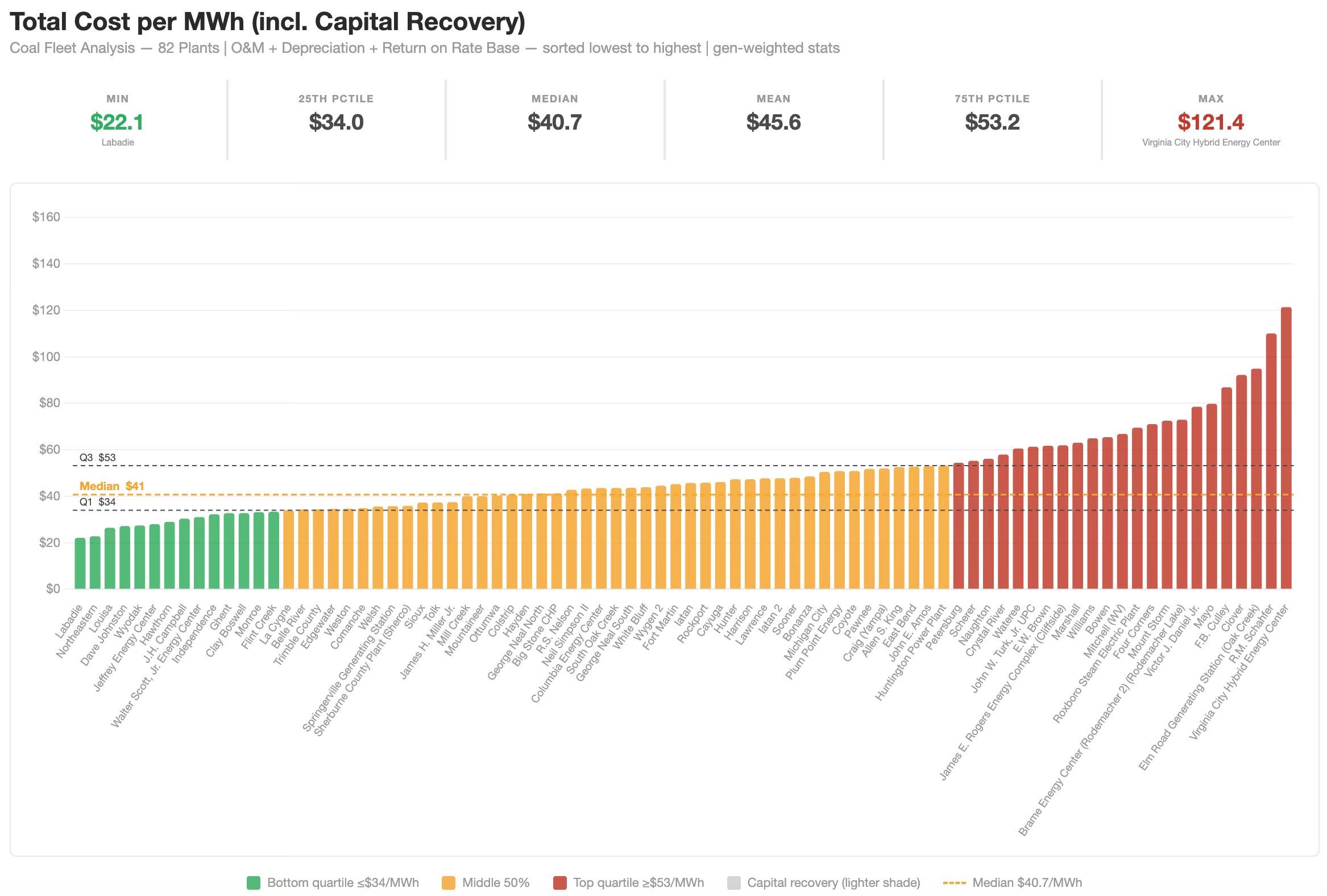
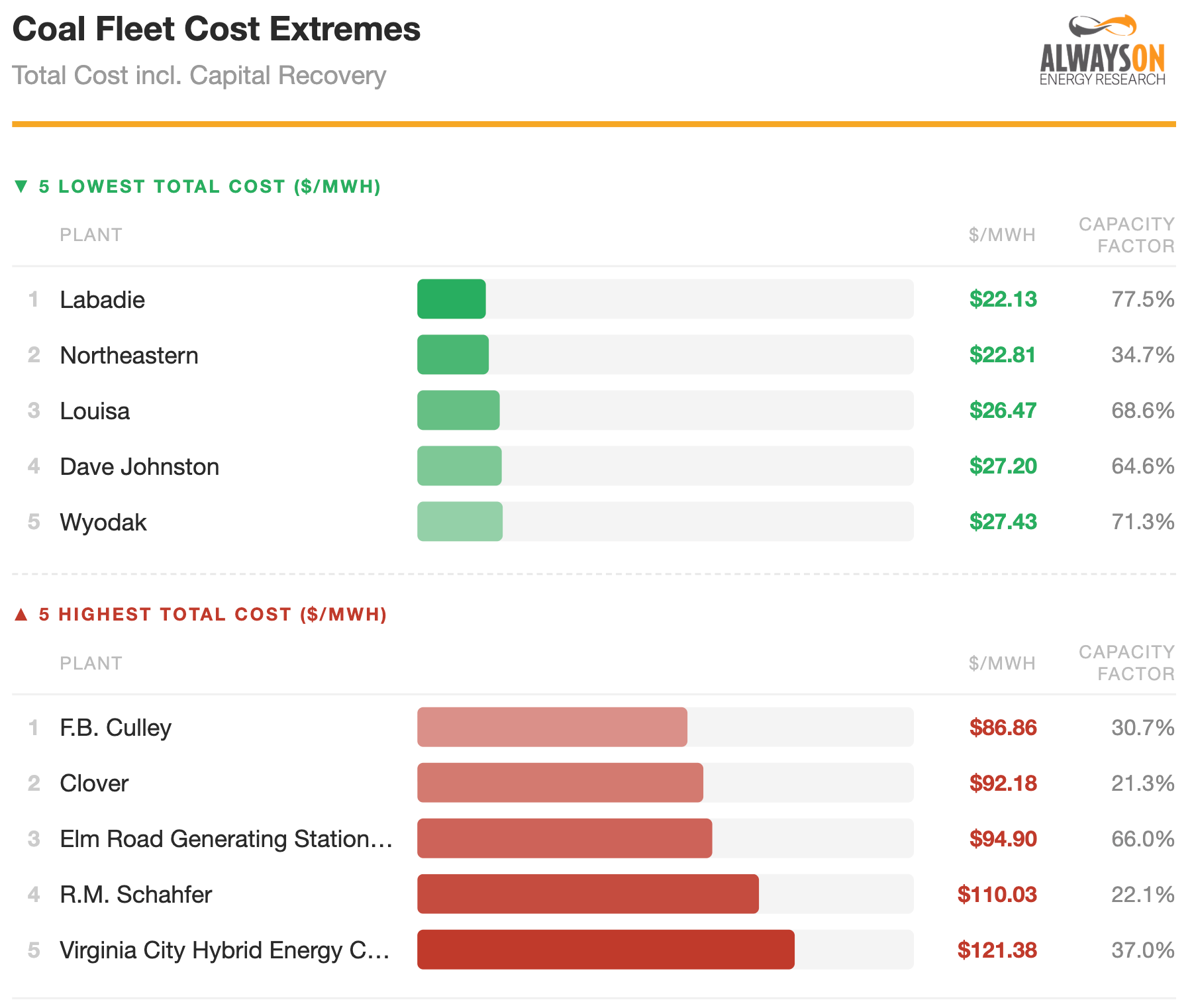
As shown in the chart below, the least expensive plants were Labadie in Missouri at $22.13 per MWh, Northeastern in Oklahoma at $22.81 per MWh, Louisa in Iowa at $26.47 per MWh, Dave Johnston in Wyoming at $27.20 per MWh, and Wyodak in Wyoming at $27.43 per MWh. The most expensive were Virginia City Hybrid Energy Center in Virginia at $121.38 per MWh, R.M. Schahfer in Indiana at $110.03 per MWh, Elm Road Generating Station in Wisconsin at $94.90 per MWh, Clover in Virginia at $92.18 per MWh, and F.B. Culley in Indiana at $86.86 per MWh.
Use it or Lose It (Affordability)
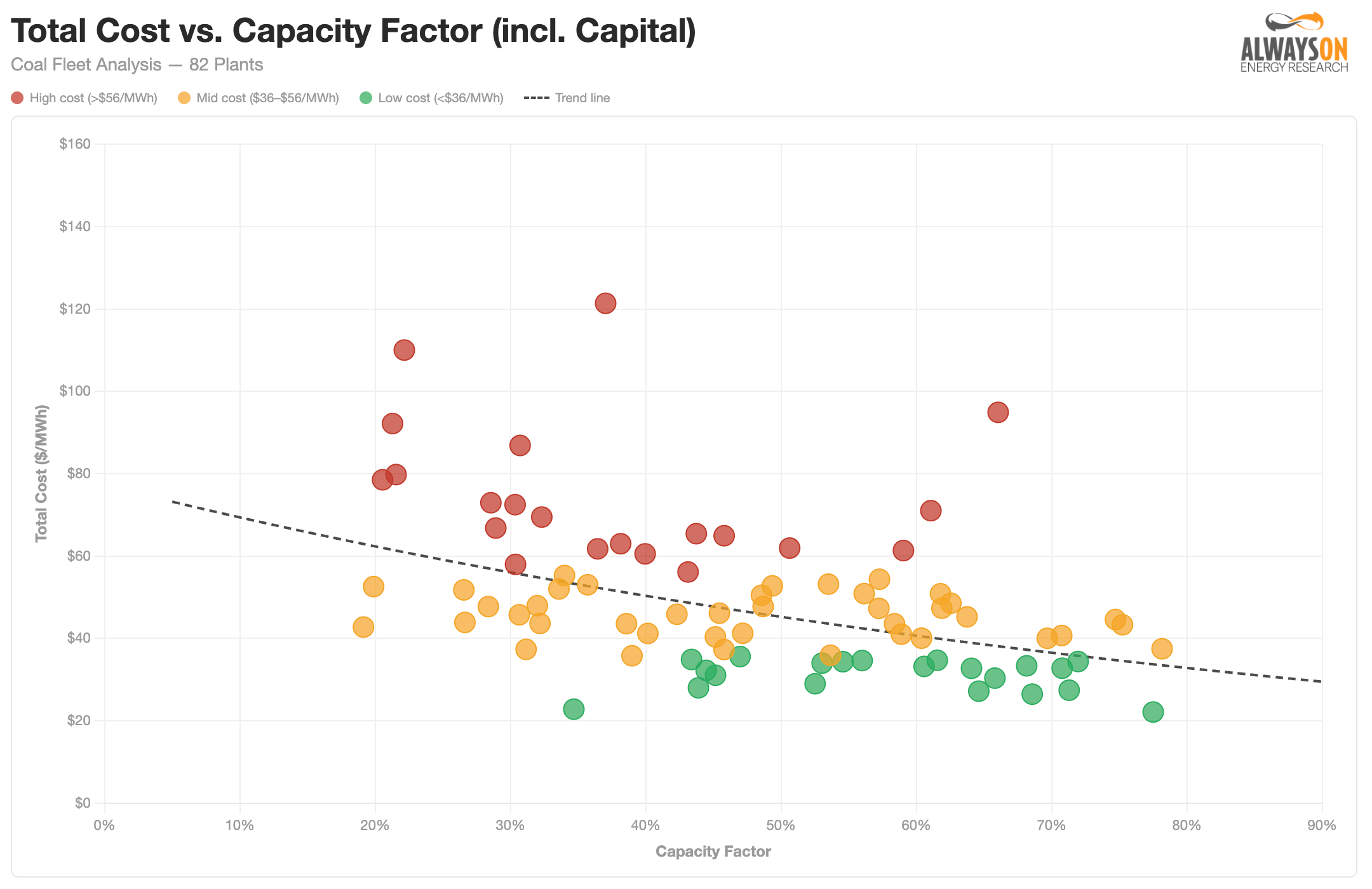
A notable difference between the most affordable and the most expensive coal plants is their utilization rates. The five most affordable coal plants in the country operate at an average capacity factor of 63.3 percent, with a notable outlier in the Northeastern coal plant.
Northeastern still has low fuel and O&M expenses, but it’s an older coal plant and operates at low capacity factors due to a multitude of factors: older plants have more outage time, it’s scheduled for retirement, and vast amounts of wind in the Oklahoma region reduce utilization rates of thermal plants, despite being needed for reliability. Jeffrey Energy Center has a similar situation: while not as old, it’s slated for retirement due to worries over EPA compliance costs, and operates on a grid with high levels of wind and natural gas.
Without Northeastern, the average of the remaining four jumps to 70.5 percent.
On the other hand, the five most expensive coal plants operate at an average of 35.4 percent, with another outlier of the Elm Road Generating Station. Elm Road is a 1,400 MW supercritical coal plant designed to operate at very high utilization. Because it carries substantial fixed staffing, engineering, and maintenance costs, operating at just 66 percent capacity leaves those costs spread across fewer MWh.
Excluding Elm Road, the average capacity of the remaining four drops to 27.8 percent.
Though not always the case, the rest of the fleet follows the same trend—plants that are utilized at higher capacity factors generally have lower costs per MWh because fixed O&M and capital costs are spread over more MWhs.
 Compared to Other Existing Plants on the Grid
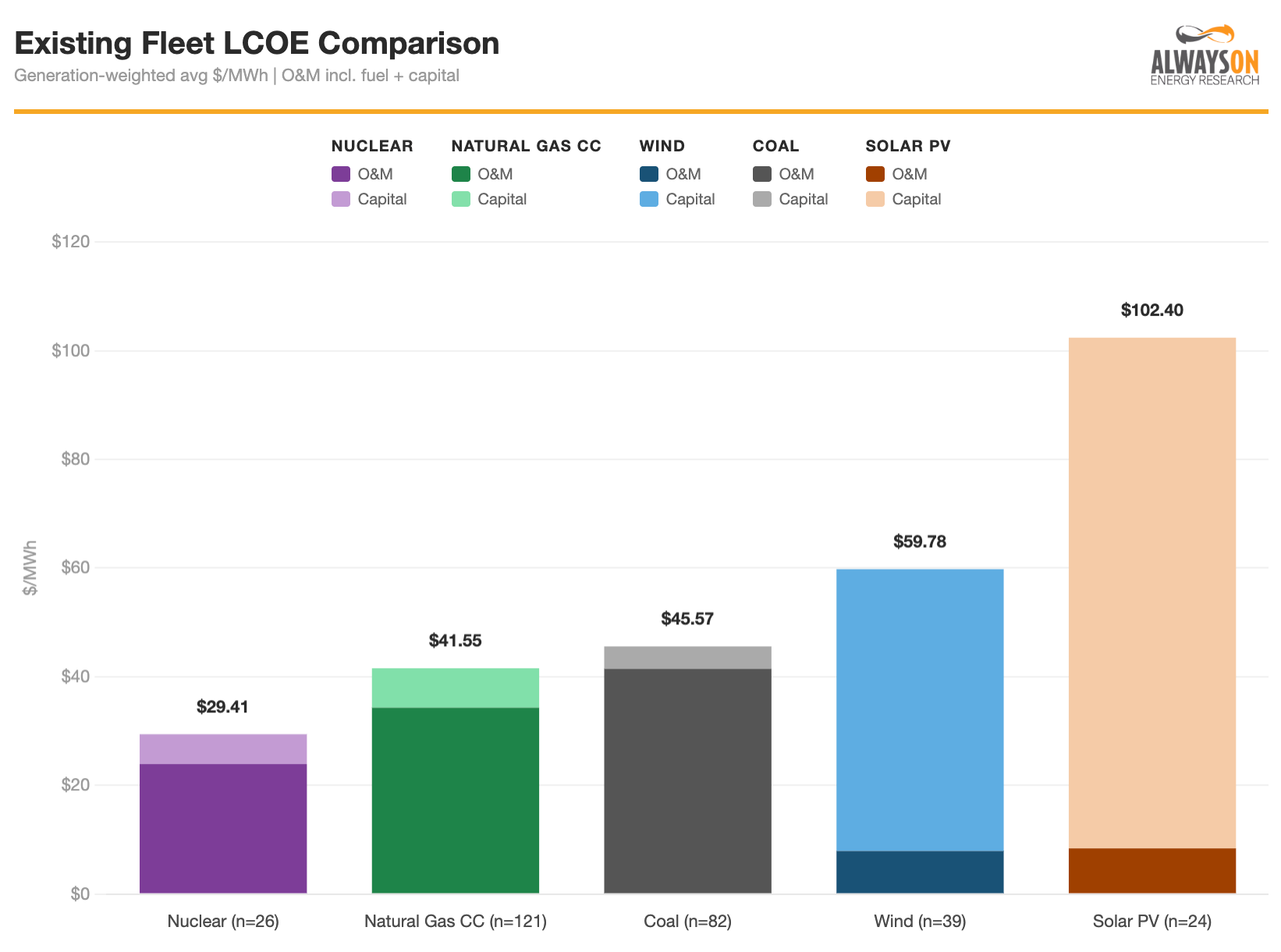
To begin with our cost comparison, it helps to start with the fact that the average coal fleet is already more affordable than existing wind and solar facilities. Nuclear is the clear winner on the grid, at a cost of $29.41 per MWh. Combined cycle natural gas is the second least expensive at $41.55 per MWh, followed closely by coal at $45.57. There is a noticeable leap to wind and solar, which come in at $59.78 and $102.40 per MWh, respectively. We pulled all available FERC Form 1 data through S&P global, and excluded all plants below 10 MW for solar.
Compared to New Wind and Solar
The value of the existing coal fleet becomes even more apparent when compared to the cost of new wind and solar facilities—which are often presented as lower cost facilities than existing coal plants. However, the data show that existing coal plants are more competitive even on a strict LCOE basis—which we all know by now is a useless metric for grid planning, but it illustrates the point that existing coal power is often among the most affordable electricity in the country even when the value of dispatchability isn’t accounted for.
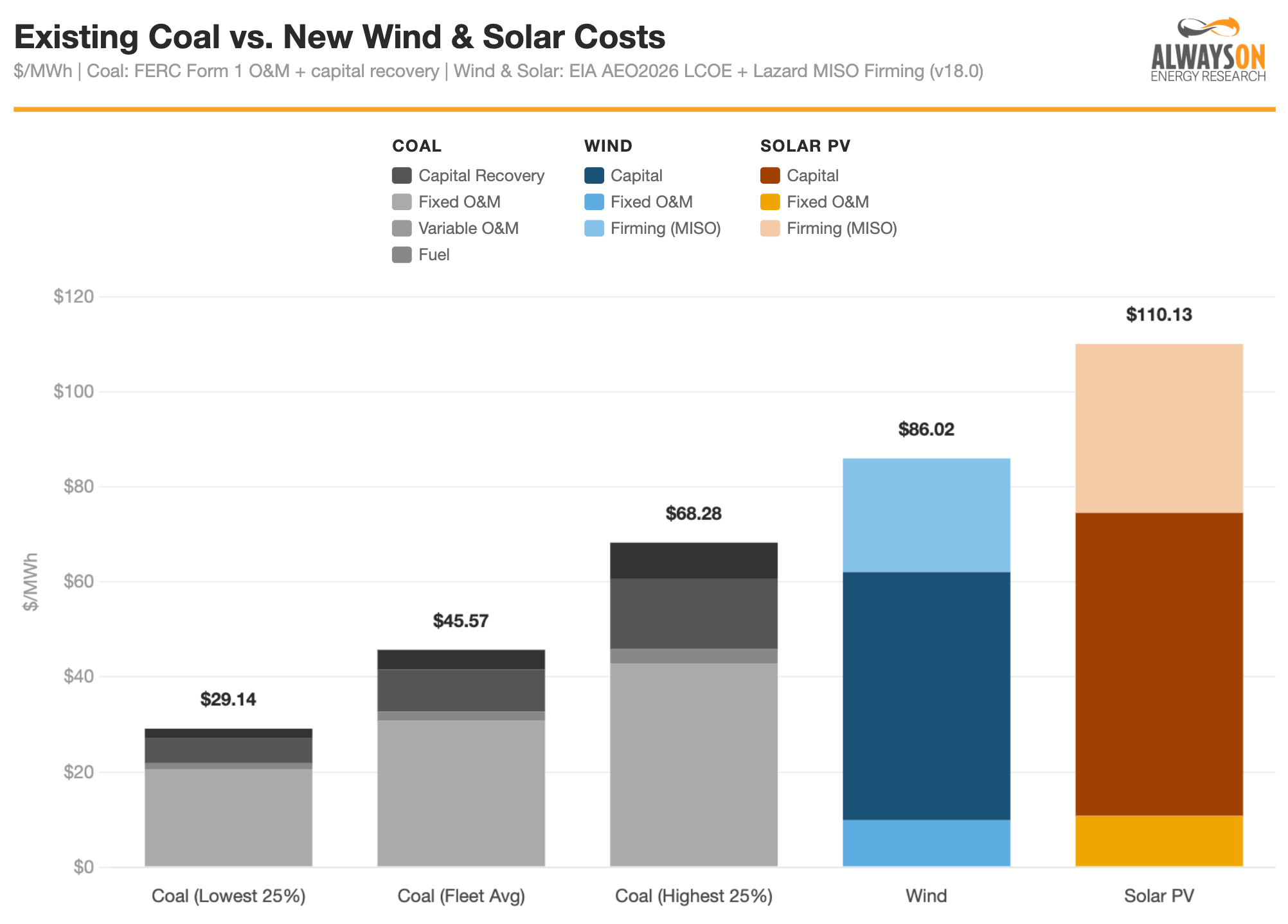
For example, according to EIA assumptions in the annual energy outlook (AEO), even without firming costs, wind is estimated at $62.09 per MWh and competes only with the 25% most expensive coal plants on the grid. Solar, at $74.55 per MWh, is only more cost-competitive than 6 out of the 82 coal plants—or 7 percent—in the analysis above.
Based on these numbers, the average cost of existing coal is 27 percent more affordable than a new wind facility, and nearly 40 percent more affordable than new solar.
When adding firming costs to wind and solar—the need for which, as we explained last week, is a growing realization in the energy industry—the gap becomes even larger, as you can see below.
We used Lazard’s firming-cost methodology for simplicity, since more robust approaches require full system modeling. At $86 per MWh based on Lazard’s methodology, wind is nearly 90 percent more expensive than the average coal fleet, and only more affordable than 5 of the 82 coal plants above—or 6 percent. Similarly, solar at $110 per MWh is 142 percent more expensive than the average coal fleet, and more expensive than 81 out of the 82 plants we analyzed.
 Even worse, Lazard’s firming cost assumes today’s grid, meaning they are dependent on existing thermal fleets. If more thermal capacity is retired, or grids become more dependent on weather-based, intermittent generation, these numbers will grow even larger. Our Always On Levelized Cost of Energy (AO-LCOE) makes this clear.
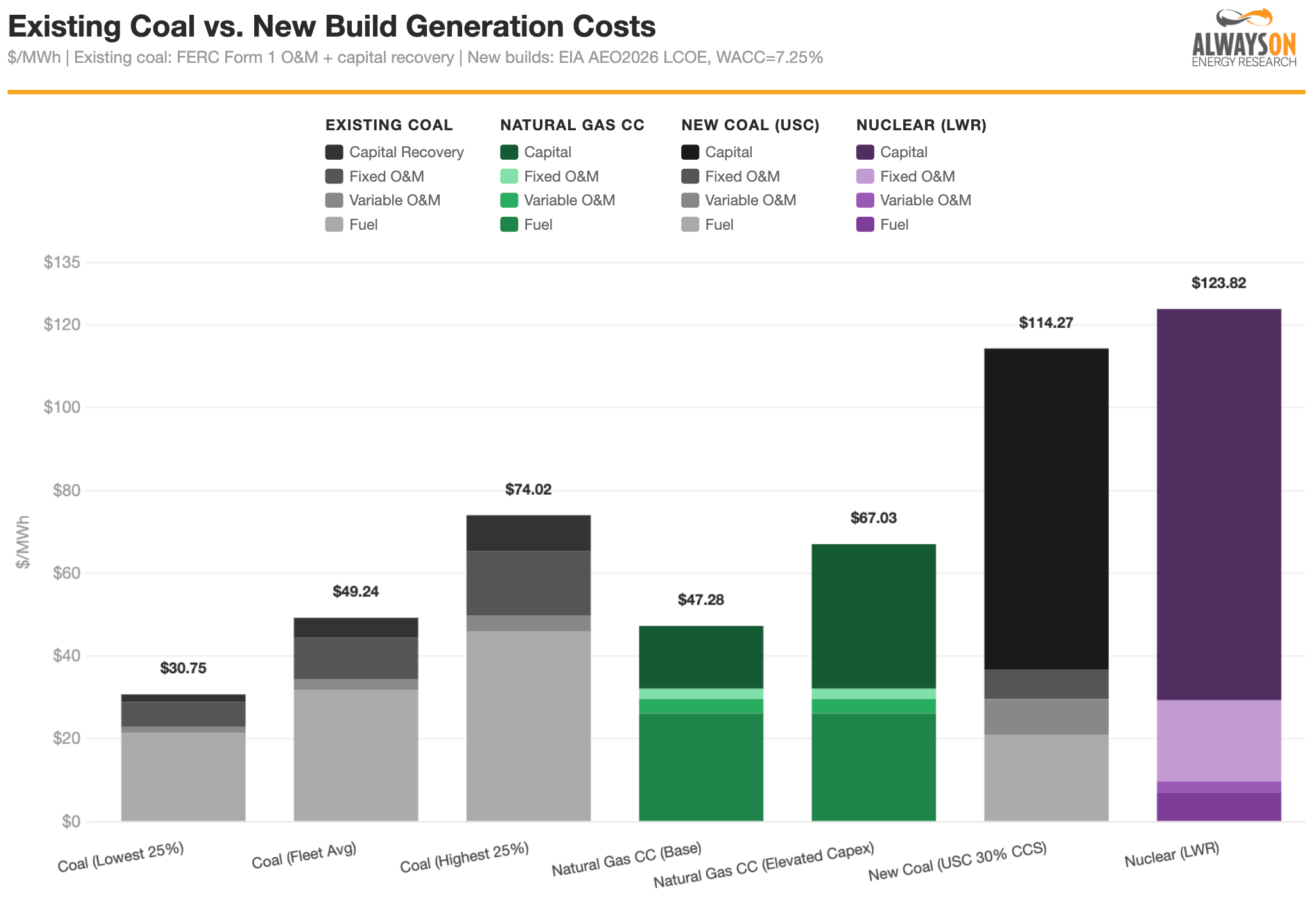
Compared to New Natural Gas and Nuclear In terms of new thermal resources, the only real competitive resource is new natural gas. According to EIA numbers, new combined cycle natural gas at $47.28 per MWh competes with the average existing coal fleet.
However, capital costs for natural gas facilities have skyrocketed since the latest EIA report, and the cost of new natural gas facilities are closer to $67.03 per MWh—which still represents the most affordable replacement capacity, but is simply less competitive with the average existing coal fleet.
A Tale of Two Plants: You, Me, and 202c
Two interesting cost outliers among the coal plants we examined are the J.H. Campbell and the R.M. Schahfer plants, both of which are operating under 90-day 202c orders issued by the DOE. According to the FERC Form 1 data presented by S&P Global, the Campbell was the eighth-most affordable coal plant in the country in 2025, generating electricity for just $30.36 per MWh, and the Schahfer plant was the second-most expensive at $110.03 per MWh.
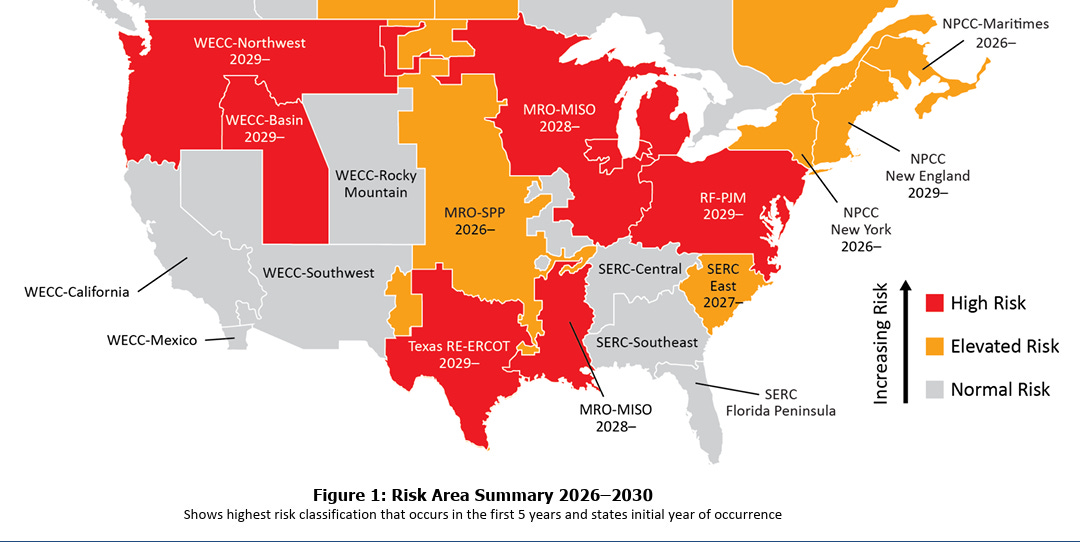
Low-Cost, but Still Under Threat Campbell was initially slated to close on May 31st, 2025, but that retirement date has been delayed because DOE deemed the plant necessary to maintain reliability in the Midcontinent Independent System Operator (MISO) region. MISO was recently designated as an area at high risk of blackouts if more existing coal plants retire and new natural gas plants don’t come online in the next few years.
Not only does the Campbell plant produce some of the most affordable electricity in the country, but it also came in clutch during Winter Storm Fern. Using Continuous Emissions Monitoring System (CEMS) data for plants 1 and 3 (data for plant 2 was not available) from S&P Global, we determined that the plants operated at a capacity factor between 64 percent and 80 percent during the cold snap.
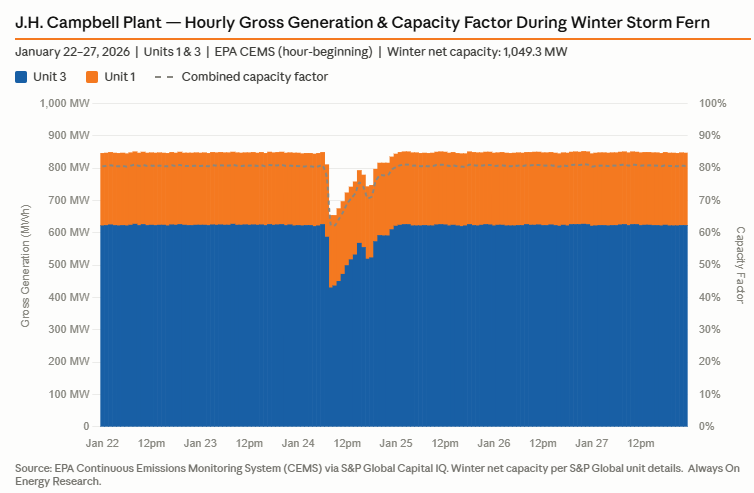
This begs the question: why is Consumer’s Energy, the owner of the Campbell plant, seeking to shut the plant down 15 years before its original retirement date, when it is so obviously one of the most reliable and affordable power plants of any kind in the entire country? The answer is Environmental, Social, and Governance (ESG). According to the company’s press release, Consumers issued a “sweeping proposal” to eliminate coal as a source of fuel for electricity by 2025. Doing so would make it one of the first major utilities to go coal-free and would accelerate its clean-energy transition, as part of executing its Clean Energy Plan and its broader net-zero carbon by 2040 goal.
Given the data at our disposal, it appears that the Trump administration’s actions to prevent the premature closure of the Campbell plan are indisputably a good thing for reliability and affordability on the power system.
High-Cost, but Still Valuable The Schahfer plant’s value proposition is harder to argue, but just because the plant isn’t an unquestioned slam-dunk to keep open long-term doesn’t mean it isn’t valuable in the short term for reliability.
EPA’s CEMS data show that Unit 17 at the Schahfer plant (Unit 18 is under a DOE order but is not operational) churned out a capacity factor of 87 percent during Winter Storm Fern, providing ~200 MW of extra power on an hourly basis compared to its normal operating levels, especially on a system at high-risk of blackouts (Schahfer is also located in MISO).
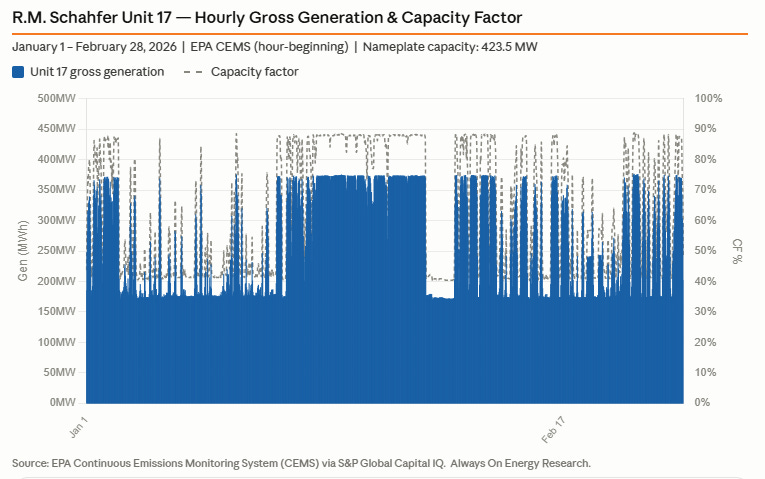 The cost of the plant is an issue, but Winter Storm Fern also demonstrated why cost isn't the only consideration. When supply tightened, Schahfer ran at nearly full output—which is exactly what the grid needs during reliability events.
The reliability crisis facing the country is largely due to the premature and excessive retirement of coal facilities in the first place—so retiring older, even higher cost facilities without adequate replacement capacity is not a solution to decades of policies that have left our electricity system underprepared and lacking supply. The cost of capacity shortfalls resulting from further closures would very likely outweigh the cost of keeping these plants open.
NIPSCO itself is part of the problem in MISO. In 2017, the utility was made up of nearly 3,500 MW of mostly coal capacity and a sprinkle of natural gas. Since then, it has retired over 1,200 MW of coal capacity (not including the Schahfer units, which would increase it to 2,200 MW) and replaced it entirely with 2,100 MW of wind and solar capacity.
At this point, the best comparison for the Schahfer plant is probably a combustion turbine natural gas plant, not a combined cycle, because Schahfer is essentially operating as a peaking and load-following resource, not a baseload resource.
Conclusion The data tell a much different story than the one we’ve been told for years.
Far from being an economic burden, much of America’s existing coal fleet remains among the most affordable sources of electricity on the grid. Existing coal plants operate at $45.57 per MWh, and nearly eight out of ten in our analysis produce electricity for less than $60 per MWh—making them more competitive than existing and new wind and solar, new nuclear, and even many new natural gas plants.
That doesn’t mean every coal plant should operate forever. Some are expensive, inefficient, or nearing the end of their useful lives. But the assumption that coal plants are inherently uneconomic and older plants are inherently unreliable, and therefore should be retired as quickly as possible, simply isn’t supported by the data.
For years, energy policy has been driven by the idea that replacing existing coal plants with new resources would lower costs while maintaining reliability. Instead, electricity prices have skyrocketed, reserve margins have tightened, and grid operators across the country are warning of capacity shortages. As it turns out, retiring some of the cheapest and most dependable power plants in America before building sufficient dispatchable replacements was never the bargain it was advertised to be.
If the goal is affordable, reliable electricity, then existing coal plants will remain essential to maintaining an affordable and reliable electric grid.
|









|