
 








|
Signature Sponsor


July 18, 2026 - Caterpillar Inc. (CAT) and Volvo (VLVLY) are global leaders in the heavy machinery and construction equipment industry, offering a wide range of products, including trucks, excavators and industrial engines. Both companies are also investing heavily in electrification, automation and digital technologies to position themselves for the next phase of infrastructure and transportation growth. Caterpillar commands a market capitalization of roughly $404 billion, significantly larger than Volvo's $72 billion. As industry bellwethers, their performance often reflects broader trends in global manufacturing, mining and infrastructure spending. But which stock looks more compelling for investors today? Let's compare their fundamentals, growth outlook and valuation.
The Case for Caterpillar
Caterpillar is the world’s leading manufacturer of construction and mining equipment, off-highway diesel and natural gas engines, industrial gas turbines and diesel-electric locomotives.
The company has reported revenue growth in each of the past three quarters and earnings growth over the past two. In the first quarter of 2026, revenues increased 22% year over year to approximately $17.4 billion, driven by higher sales volumes across all business segments. Backlog reached a record $63 billion. Adjusted earnings per share jumped 30.4% to $5.54, a sharp acceleration from the modest 0.4% growth recorded in fourth-quarter 2025. The results were particularly impressive considering the estimated $600 million tariff-related headwind during the quarter.
For 2026, Caterpillar expects revenue growth in the low double digits compared with 2025. Adjusted operating margin is, however, projected toward the lower end of its range, due to continued tariff pressures, which are expected to create a full-year headwind of approximately $2.2-$2.4 billion.
At an annual revenue base of roughly $60 billion, Caterpillar expects adjusted operating margins between 15% and 19%. If revenues reach $72 billion, margins could improve to 18-22%, while a stronger scenario with $100 billion in revenues could support margins of 21-25%.
Caterpillar is targeting a revenue CAGR of 6-9% through 2030. Key growth catalysts include U.S. infrastructure spending, mining demand tied to the energy transition, increased automation adoption and expanding investments in data centers and sustainability initiatives. Caterpillar recently strengthened its mining technology capabilities by acquiring Skycatch, Inc., a provider of spatial data capture, processing and analytics solutions for the mining industry.
Management aims to increase Construction Industries sales to users by 25% from 2024 levels by 2030, triple the number of autonomous trucks operating in Resource Industries and expand Power Generation sales to more than three times their current level.
Connected assets are expected to rise from more than 1.6 million to 2 million, while e-commerce sales per business day are projected to jump from 4% to more than 50% by 2030. Services revenues are targeted to rise from $24 billion in 2025 to $30 billion by 2030.
Caterpillar’s growth is expected to be driven by U.S. infrastructure spending, mining demand linked to energy transition, automation adoption and rising data center and sustainability-related investments.
The Case for Volvo
Volvo is one of the leading manufacturers of trucks, buses and construction equipment, as well as marine and industrial engines. Its subsidiary, Volvo Construction Equipment (Volvo CE), produces a wide range of machinery for the construction, extraction, waste processing and materials handling sectors. It manufactures haulers, wheel loaders, excavators, road construction machines and compact equipment.
Volvo Group’s net sales were up 3% in the recently reported second quarter of fiscal 2026 to SEK 126.3 billion ($13.1 billion). The Group has returned to revenue growth after nine quarters of declines. Organic sales growth was 7%.
Adjusted operating income rose 10% year over year to SEK 14.8 billion, lifting adjusted operating margin to 11.7% from 11.0% in the year-ago quarter. Strong service revenues, favorable product mix and lower net R&D expenses more than offset higher U.S. tariff costs along with rising freight and material expenses. Vehicle sales grew 6% and service sales 7% organically. Deliveries of new trucks increased 6%.
Earnings per share grew 40% to SEK 5.10 (53 cents) in the second quarter. This marks an improvement from the 16% decline witnessed in the first quarter.
Volvo CE, however, reported net sales decline of 6% to SEK 21.6 billion ($2.24 billion), largely due to the divestment of SDLG in September 2025. Organic sales growth was reported at 13%, of which net sales of machines increased 14% and service sales increased 9%
Total deliveries fell 48% because of the SDLG divestment, although deliveries under the Volvo brand increased 14%. Growth was led by North and South America, Europe and Asia, partly offset by weaker demand in Africa and Oceania. North America remained resilient, supported by investments in data centers, energy infrastructure and reshoring of manufacturing. South America benefited from stronger mining and infrastructure activity, while Europe saw healthy replacement demand and ongoing infrastructure investment.
Adjusted operating income at Volvo CE increased 4% to SEK 3.1 billion ($320 million), while adjusted operating margin improved to 14.4% from 13.1%. Better product mix and stronger service performance more than offset lower volumes and tariff-related costs. In the first quarter, adjusted operating income had dipped 2% owing to the impact of tariffs.
Strategically, Volvo continues to invest in innovation and capacity expansion. Volvo CE has delivered the world's first electric articulated haulers, Volvo A30 Electric, to LNS in Norway for use on a hydropower project, marking a key milestone in the electrification of heavy equipment.
Volvo CE recently began construction of its new crawler excavator assembly factory in Eskilstuna. The 30,000-square-meter plant, expected to be completed in 2028, will expand production capacity to meet growing European demand. The move is also in sync with Volvo CE’s goals to solidify its position in the key excavator market. Volvo CE completed its acquisition of Swecon in January 2026, strengthening its retail and service presence across Sweden, Germany and the Baltic region. The company also divested its loss-making Rokbak business to sharpen its focus on its core hauling solutions.
While these initiatives position Volvo for long-term growth, near-term performance remains impacted by higher costs owing to tariffs, restructuring actions and weakness in some regions.
How do Estimates Compare for CAT & VLVLY?
The Zacks Consensus Estimate for Caterpillar’s 2026 earnings is $24.86 per share, indicating year-over-year growth of 30.4%. The estimate for 2027 of $31.11 suggests a rise of 25.1%.
The consensus estimate for Volvo’s 2026 earnings is $2.19 per share, indicating year-over-year growth of 26.6%. The 2027 estimate of $2.70 implies growth of 23.1%.
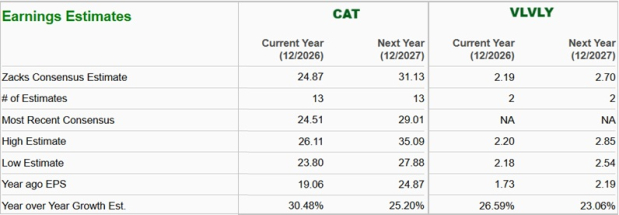 Image Source: Zacks Investment Research
EPS estimates for Caterpillar for both 2026 and 2027 have been trending north over the past 60 days. The estimates for Volvo for both years have moved down over the past 60 days.
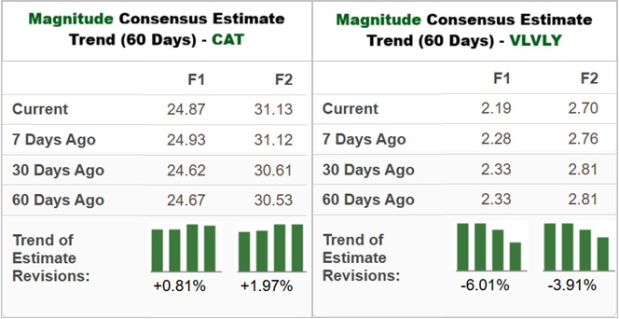 Image Source: Zacks Investment Research Caterpillar & Volvo: Price Performance, Valuation & Other Comparisons
In a year, CAT stock has surged 112.1%, whereas VLVLY has gained 32.6%.
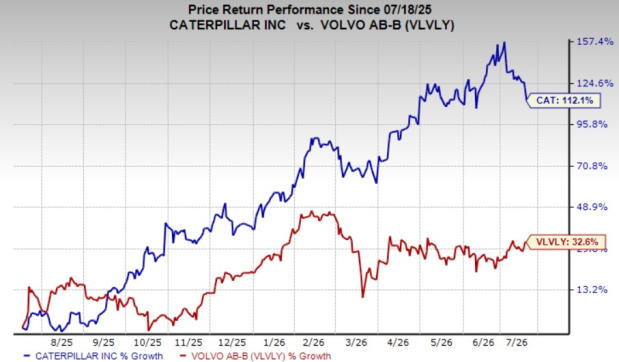 Image Source: Zacks Investment Research
Caterpillar is currently trading at a forward 12-month earnings multiple of 31.27X.
Volvo’s stock is trading at a forward 12-month earnings multiple of 13.93X.
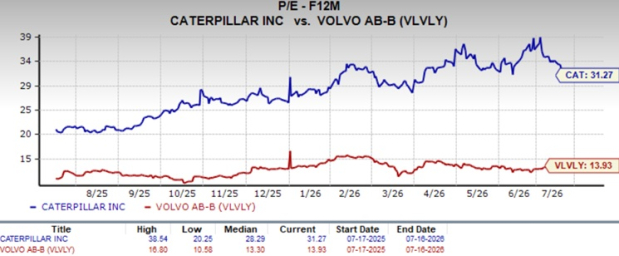 Image Source: Zacks Investment Research
CAT’s return on equity of 48.21% is way higher than VLVLY’s 22.17%. This reflects Caterpillar’s efficient use of shareholder funds in generating profits.
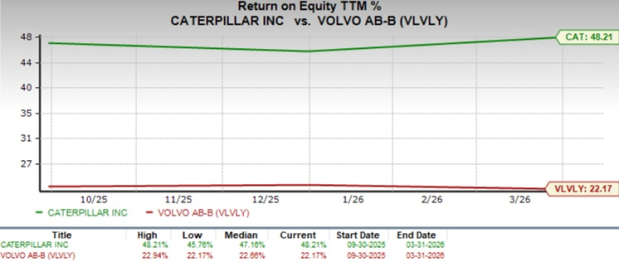 Image Source: Zacks Investment Research
CAT or VLVLY: Which Stock is Better for Your Portfolio?
Both Caterpillar and Volvo offer investors exposure to long-term infrastructure, mining and industrial equipment demand. However, Caterpillar stands out for its scale, consistent performance, strong backlog and improving earnings outlook, even as it navigates cost pressures. Volvo is making meaningful progress through electrification, acquisitions and capacity expansion, but its construction equipment business continues to face revenue pressure and analysts have become more cautious about its earnings outlook.
Despite a higher valuation, Caterpillar's stronger execution, superior returns on equity and improving earnings estimates make it a better investment opportunity at present. Caterpillar currently carries a Zacks Rank #3 (Hold) while Volvo carries a Zacks Rank #4 (Sell).
|









|