
 








|
Signature Sponsor


July 21, 2026 - The world is using more electricity than ever, but where this energy comes from is changing. Renewable sources like wind and solar power are growing rapidly, especially in certain parts of the world. Here’s a closer look at long-term trends in global energy production, based on a Pew Research Center analysis of data from Ember, an independent think tank focusing on global energy trends.
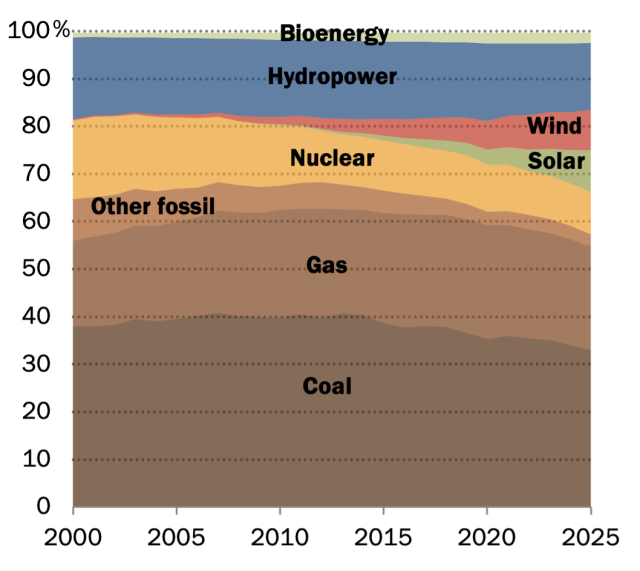
Most electricity still comes from burning fossil fuels. But a growing share comes from wind and solar power. Worldwide, 57% of all electricity generated in 2025 came from burning coal, gas or other fossil fuels, down from 65% in 2000.
 Note: “Other fossil” includes generation from oil and petroleum products and manufactured gases and waste. “Other renewables,” which includes geothermal, tidal and wave power, is not shown (<1%).
Source: Ember, “
Yearly Electricity Data” (accessed June 23, 2026).
PEW RESEARCH CENTER
Coal in particular has seen a decline over the past decade: In 2025, a third of all global electricity came from burning coal, down from a peak of 41% in 2013.
By contrast, wind and solar power account for a rising share of global electricity generation. These two sources together accounted for 17% of all global electricity in 2025, compared with less than 5% in 2015.
In 2025, renewable sources – wind, solar, bioenergy, hydropower, geothermal, tidal and wave – accounted for a slightly larger share of global electricity production than coal for the first time (34% vs. 33%).
Nuclear energy, meanwhile, has declined as a source of electricity, falling from 17% of global generation in 2000 to 9% in 2025.
It’s important to note that global electricity demand has increased sharply in recent decades. As a result, the use of certain energy sources has increased in absolute terms, even as those sources have decreased as a share of total electricity production. Hydropower, for example, is producing a far greater volume of electricity today than in 2000, even though it has declined as a share of all electricity.
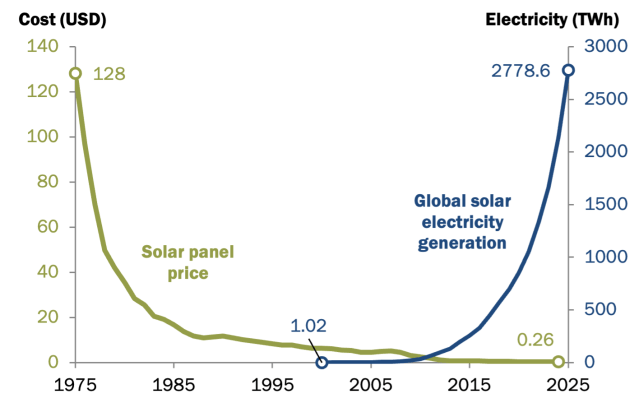
Solar power has grown especially rapidly in recent years. In 2025, 9% of the world’s electricity came from solar power. That was up from 3% in 2020 and just 0.01% at the turn of the century.
One reason for this increase is that solar panels have become far more affordable over the last 50 years. The price of a single panel has fallen by more than 99%, from an average of $128 in 1975 to just $0.26 in 2024, the most recent year with available data.
 Note: Costs are expressed in constant 2024 U.S. dollars per watt.
Source: IRENA (2025), Nemet (2009), and Farmer and Lafond (2016) via Our World in Data, “Solar photovoltaic module price”; Ember, “
Yearly Electricity Data” (accessed June 23, 2026).
PEW RESEARCH CENTER
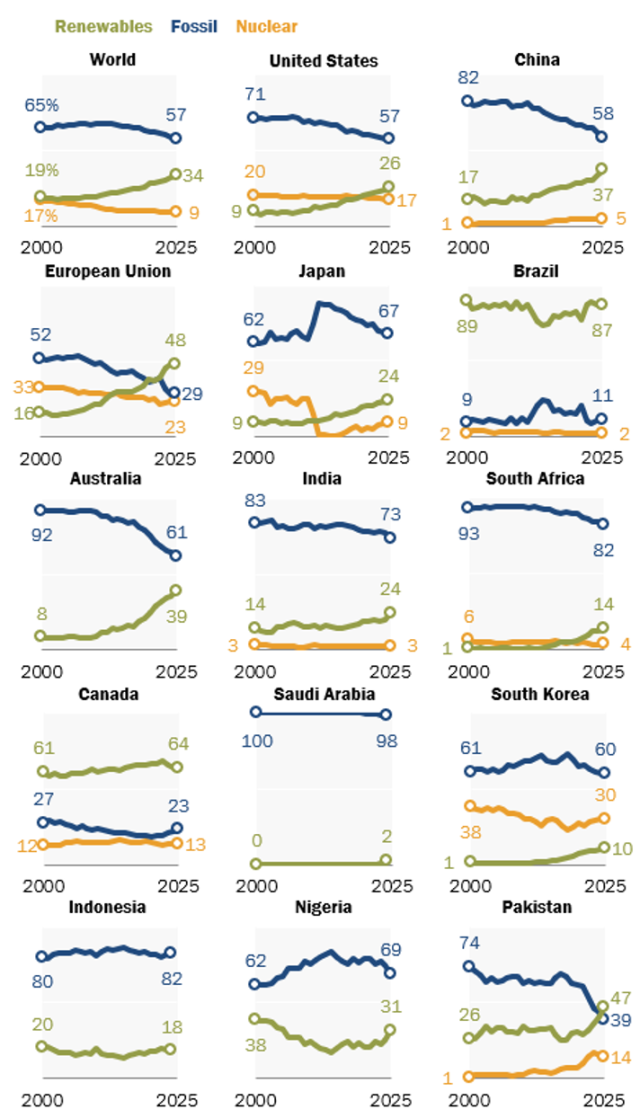
In the European Union and elsewhere, renewables are now the biggest source of electricity. In 2025, nearly half of all electricity in the EU (48%) came from renewables, while 29% came from fossil fuels and 23% came from nuclear power.
 Note: Renewables include wind, solar, bioenergy, hydropower, geothermal, tidal and wave power. Nuclear is not shown for countries with no nuclear power plants. Current data series for Indonesia and Saudi Arabia end in 2024.
Source: Ember, “
Yearly Electricity Data” (accessed June 23, 2026).
PEW RESEARCH CENTER
In Brazil and Canada, renewables have long accounted for the majority of all electricity generated (87% and 64% in 2025), driven largely by hydropower but also the expansion of wind and solar.
China and the United States have both increased their use of renewables and decreased their reliance on fossil fuels for electricity in the last 25 years. Today, 37% of China’s electricity and 26% of U.S. electricity comes from renewable sources.
And in Pakistan – where around three-quarters of electricity came from fossil fuels in 2000 – a recent surge in solar adoption led renewable sources to overtake fossil fuels as of 2025.
Nuclear energy as a source of electricity varies considerably by country. Japan, for example, shut down most of its nuclear power plants after the Fukushima accident in 2011 but has steadily returned to this source in recent years, along with increased use of renewables.
Australia has maintained a strict ban on nuclear energy since 1998. Saudi Arabia – a major producer of oil and natural gas – also has no nuclear energy generation, and nearly all of its electricity (98%) came from fossil fuels in 2025. Saudi Arabia plans to develop a civil nuclear program under its Vision 2030 plan, which in part aims to reduce the country’s dependency on fossil fuels.
In addition to generating far more total electricity than any other country, China leads the world in solar and wind energy production. By total output in 2025, it generated more solar and wind power than the 38 nations in the Organisation for Economic Co-operation and Development combined. The U.S. led the world in nuclear and natural gas electricity generation that year.
|









|