



|
Signature Sponsor

October 13, 2026 - Coal dust, a decades-long scourge for thousands of residents of Hampton Roads cities where mammoth coal terminals operate, could be less of a menace in Newport News if local officials and businesses follow the recommendations in a new study.
But getting funding from the wealthy terminal operators? Don’t hold your breath.
Dust Solutions Inc., a South Carolina-based company that designs and manufactures equipment to battle the residue, recommended erecting an 80-foot-tall, semi-porous fence in Newport News to block wind from blowing dust off the terminals’ massive coal piles near Interstate 664, WHRO recently reported.
Kinder Morgan and Dominion Terminal Associates separately own the two Newport News coal terminals.
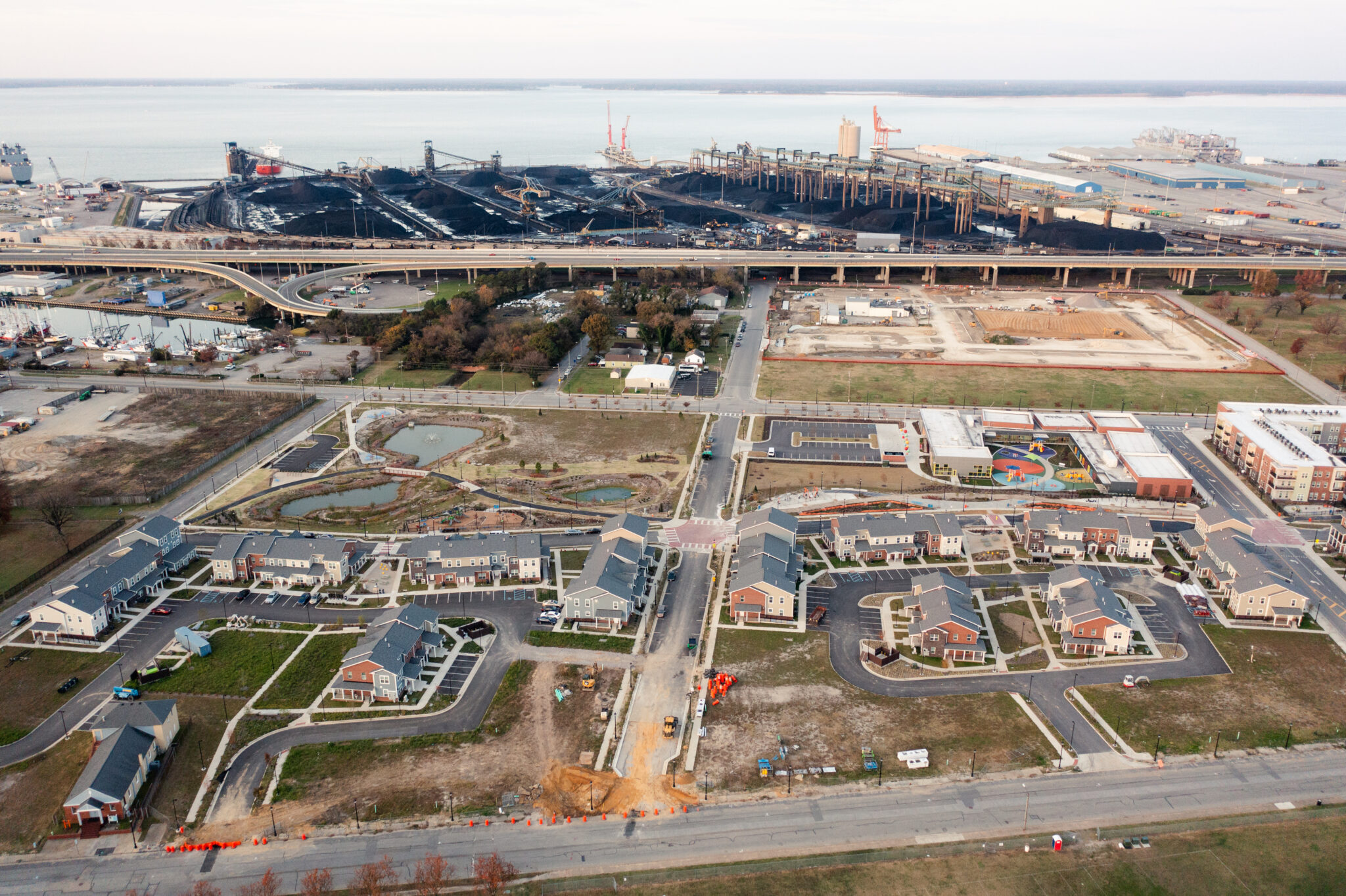
This coal transfer terminal in Newport News sits close to many homes in the majority Black East End neighborhood. Photo courtesy of Cornell Watson for the Southern Environmental Law Center
The study, sought by city officials but paid for by private donors, noted that a fence could reduce the amount of some particles escaping the piles by 89%. Kinder Morgan currently uses wet suppression to lower dust – basically hosing down the towering piles with water. Dominion Terminal Associates didn’t respond to my questions about its operations or the study.
Coal dust has long been a nuisance – and a possible threat to human health – for residents of the Southeast Community, a largely African-American neighborhood also known as the East End.
The price tag for the fencing is a not-insignificant $12 million to $22 million, WHRO reported. Nor did either terminal company tell me they were willing to foot the bill – though that amount is a relative pittance to their bottom lines.
That means taxpayers would have to pick up the cost if the city or state eventually oversees the construction.
I’m usually wary of studies in which the authors might benefit financially from the prescribed solution. That poses a conflict of interest in the study’s design and conclusion.
Yet, it’s reasonable to think anything that could significantly lower the dispersal of dust would be a good thing. Some residents attribute their family’s health problems, especially cancer or pulmonary-related conditions, to the proximity of coal terminals and the uncovered trains that transport the stuff.
“The clouds of dust contain heavy metals such as arsenic, lead, and mercury, as well as silica,” the Southern Environmental Law Center noted in an article in May. “The dust is known to cause and worsen respiratory issues such as asthma, COPD, and to increase the risk of cancer.”
Yugonda Sample-Jones, founder and CEO of the East End Civic Association in Newport News, believes her son’s asthma years ago was linked to the terminals.
“We see the coal terminal over there … It’s the backdrop of all our health issues,” Sample-Jones, 47, told me in an interview.
“We’re not benefiting from this billion-dollar industry,” she added.
“I wipe coal dust off my mailbox often,” said Joni Ivey, a local resident and retired chief of staff for U.S. Rep. Bobby Scott, D-Newport News.
Coal from Appalachia has been coming to Hampton Roads since the 1880s. As news articles and businesses note, the terminals in Newport News and at Lamberts Point in Norfolk together export more coal than anywhere else in the country.
If the terminal owners wanted to be better corporate citizens, they could certainly pay for this solution or an alternative. They seem more concerned, though, about their shareholders than the residents they’ve impacted negatively for so many years.
Kinder Morgan, with its 11,000 employees and 136 terminals across North America, has an enterprise value of nearly $102 billion. (“Enterprise value” measures a company’s total value by combining its market capitalization with debt and subtracting the cash.)
Dominion Terminal Associates’ website says it operates as a Virginia limited liability partnership. However, it’s owned by Alpha Metallurgical Resources and Core Natural Resources. AMR’s enterprise value is nearly $2 billion; Core Natural’s enterprise value is just under $4.6 billion.
It’s not just that the dust is a nuisance. Concerns about health are always near the surface for residents living near the terminals.
As a Virginian-Pilot editorial noted last month: “Health studies suggest residents suffer from asthma at a significantly higher rate than elsewhere in the region or state. Other chronic diseases are also found at noticeably high rates.”
Residents, though, complain there have been more than enough studies over the decades; I found one that the state conducted 39 years ago. How many are needed?
Besides, residents know folks who have gotten sick, and they know how much coal residue lands on their homes, cars and in their air filters.
Nor should the Virginia Department of Environmental Quality evade scrutiny. Activists have long considered the agency too timid in enforcing current air and water quality regulations and being too deferential to Big Business at the expense of residents’ health. A 2019 report said the agency’s programs had been hamstrung by outdated state regulations.
Environmental activists often battled with David Paylor, agency director from 2006-2022, saying he regularly sided with polluters over the environment. They also criticized the agency for its minimal $27,000 fine against Norfolk Southern in 2020 for an earlier train derailment. The derailment caused 16 boxcars to spill almost 1,400 tons of coal into the Roanoke River.
DEQ is finally embarking on a long-delayed project to study and reduce the potential health risks associated with dust coming from coal storage and transportation facilities in Newport News and Norfolk. It’s called the Tidewater Air Monitoring Evaluation project and will measure and analyze toxic metals and particulates in the air.
Regarding the Newport News coal terminals, Irina Calos, a DEQ spokeswoman, said by email that Dominion Terminal Associates has one air permit, issued July 17, 2012, and Kinder Morgan has two air permits, issued Sept. 12, 2013, and April 29, 2021.
“Both facilities are classified as synthetic minor sources, and permits for minor sources remain effective until there is an event that would require a change to a permit, e.g., the facility makes a physical or operational change that would increase its air pollution or there is a violation of air quality standards,” Calos added.
Mark Sabath, senior attorney at the SELC, told me in an interview the permitting process should be more robust. “There are facilities all over the country and abroad that are doing more” to fight coal dust blowing off properties into neighborhoods, he said.
“It’s fair to call this an example of environmental injustice,” Sabath noted. The term refers to disproportionate hazards and pollution borne by minority and low-income neighborhoods.
Taylor Smith, a Kinder Morgan spokesman, told me the company continues to evaluate dust-control practices. “Third-party railcars received at the facility are unloaded within a fully enclosed building,” he said by email.
The company also remains “committed to operating in compliance with all applicable regulatory requirements.” If those requirements are weak, though, residents feel the fallout – literally.
The clincher: “We are not currently pursuing a wind-fence project at the facility,” Smith said.
As I said earlier, Dominion Terminal Associates never responded.
The proposed wind fence is no panacea. Some environmental advocates have acknowledged as much.
It would go a long way, however, to helping a long-suffering community fight coal dust. It definitely would lead to a better outcome than the persistent dust that now wafts over everyone in the Southeast Community. |





|