








|
Signature Sponsor


October 16, 2026 - Coal market prices rallied in September, supported by firmer natural gas prices and strong export demand. US coal exports are expected to rise year over year, but overall volumes are expected to fall as domestic thermal demand remains sensitive to the price of gas. Elevated coal stockpiles in 2026 may further limit demand heading into 2027. Recent export growth has been driven mainly by a recovery in global metallurgical coal markets, with demand growth in India and eased tariffs in China. Gas remains competitively priced for generation in regions with coal plants, with firmer gas prices mainly centered on the US Gulf Coast. Combined with high coal stockpiles, we forecast constrained coal production through 2027. Although natural gas prices are expected to normalize after 2027, the US coal market will face renewed pressure from the expansion of solar and wind generation in regions with supportive economics and state policies. The S&P Global Market Indicative Power Forecast further projects coal plant retirements and reduced utilization through 2035, when 44.4 gigawatts of coal plants are forecast to retire. Coal plant generation share is forecast to decline to 7.2% through 2035, down from 16.3% of total generation in 2027. Coal benchmark prices gained through September, as gas prices firmed somewhat on summer peak electricity demand. Coal stockpiles remained high, constraining the boost in domestic prices. Export benchmark prices rallied the most, with CAPP region export benchmarks up $3.00/short ton to $84.00/st (3.7%), NYMEX CAPP also up $2.00/st to $81.00/st (2.5%), and NAPP Pittsburgh Seam 13,000 British thermal units per pound up $1.75/st to $72.00/st (2.5%). Domestic coal benchmark prices moved modestly higher, with Illinois Basin 11,500 mid-sulfur gaining $0.75/st to $54.75/st (1.4%), while the NYMEX Powder River Basin benchmark added $0.15/st to $14.65/st (1.0%). US gas prices firmed up on the Gulf Coast while moving lower in the Northeast US. Henry Hub spot prices opened in September at $2.90/million Btu, rising steadily to close at $3.18/MMBtu. Spot prices averaged $2.94/MMBtu for the month. Seasonal storage injections continued at a steady pace, with working gas at 3,351 billion cubic feet as of Sept. 18. This was 95 Bcf above the five-year average and 146 Bcf below the same week of 2025. Summer weather eased substantially in the Northeast US, while September weather was warmer in the rest of the US. Chicago Gate averaged $2.69/MMBtu, a $0.25/MMBtu discount to Henry Hub. TCO Pool's discount widened to $1.24/MMBtu, with a monthly average of $1.70/MMBtu, while TETCO M3 moved to a discount of $1.36/MMBtu, with a monthly average of $1.58/MMBtu. September natural gas draws for generation trended above normal in the Western US, with SoCal Border near parity with Henry Hub at $2.83/MMBtu during the month. The US Energy Information Administration (EIA) estimated June coal stockpiles at 118 million st, 2 million st lower than in May. The modest drawdown going into the summer indicates continued robust inventories through the end of 2026.
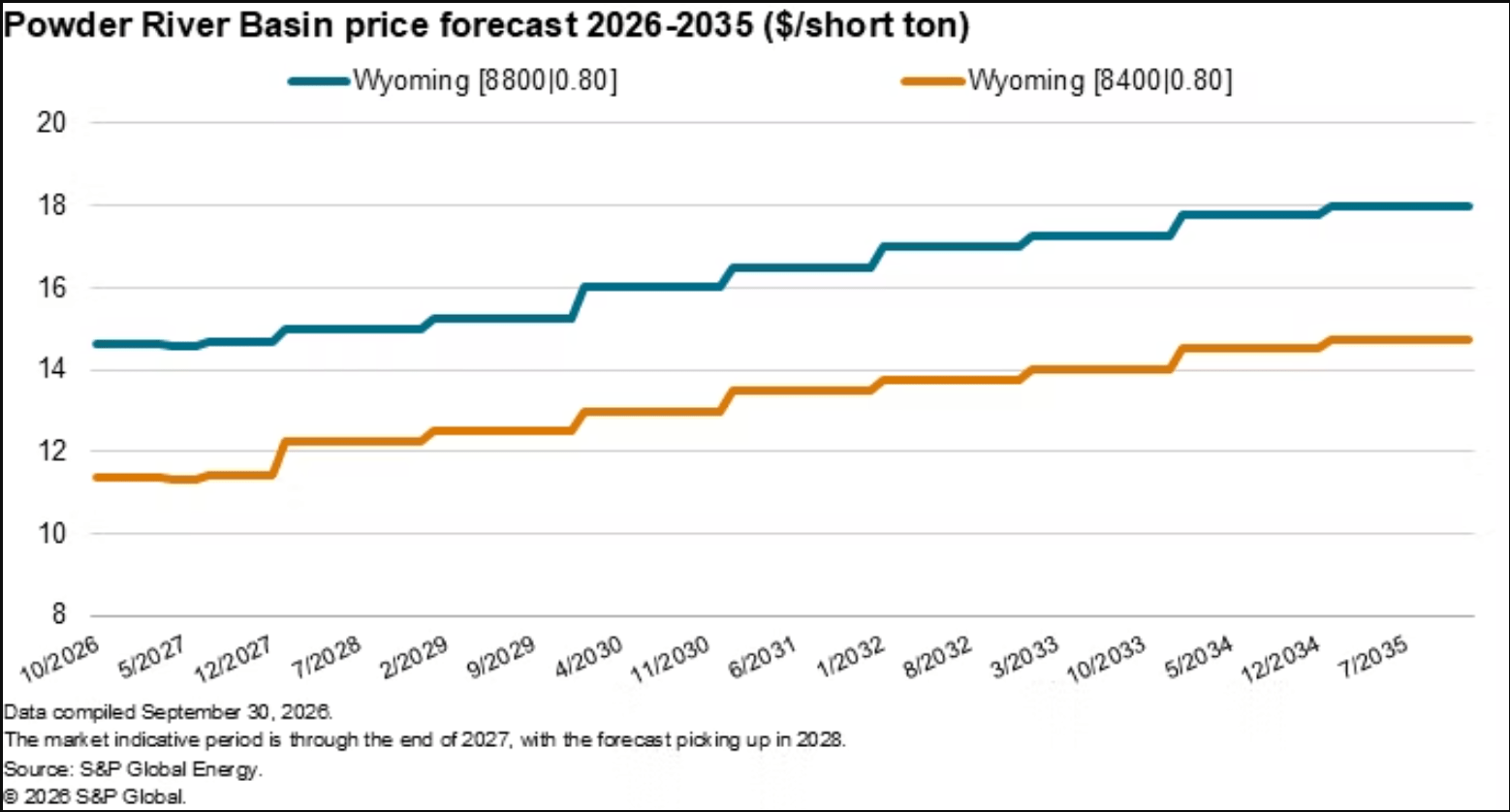
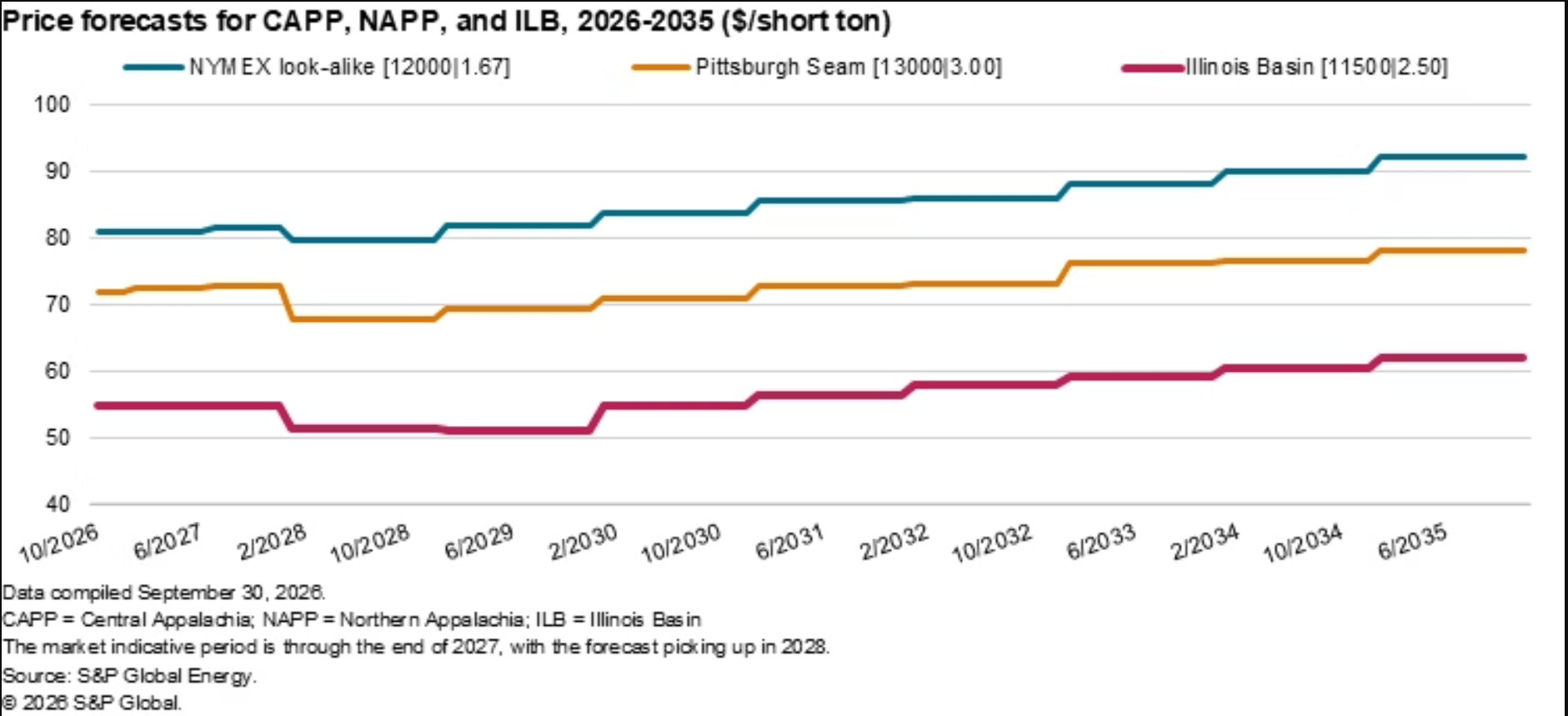
Current forward pricing for Powder River Basin (PRB) coal has been flat and stable, reflecting surplus inventories at power plants. After 2027, declining coal demand is forecast to be offset by rising unit costs, driving modest price growth. Bituminous coal prices are primarily influenced by export markets, with today's prices making domestic coal generation uncompetitive, relative to Northeast natural gas. The current disruption in international energy markets has elevated export coal prices, likely through 2027. As natural gas prices normalize after 2027, we project flat-to-easing coal prices.
Pricing benchmarks exceeding $70/st suggest sustainable returns for eastern bituminous coal, with Atlantic Basin export coal above that threshold and coal competing in Pacific Basin export markets generally much closer to that threshold. Bituminous coal demand for electricity generation is expected to remain stable through 2027, driven by higher electricity demand. Declines in steam coal demand are expected to resume after 2027, and overall Eastern US coal demand is forecast to decline 55 million st in 2025-30. Outlook for US coal production, demandFor the four weeks ending Sept. 19, coal shipments averaged 10.2 million st, 2.8% below the same period in 2025, as summer weather conditions persisted across much of the US. The chart below compares the current production forecast with recent history. We forecast production at 510 million st in 2026, a 3.2% decline from 2025, as milder overall weather conditions and lower natural gas prices suppress coal demand. We forecast flat production in 2027, with higher natural gas prices offset by robust coal inventories. Beginning in 2028, growth in generation from natural gas and green energy is forecast to reduce coal generation. The overall coal market, including domestic demand and exports, is forecast to decline 122 million st between 2026 and 2031. Production outlook — Powder River Basin |








|