









|
Signature Sponsor


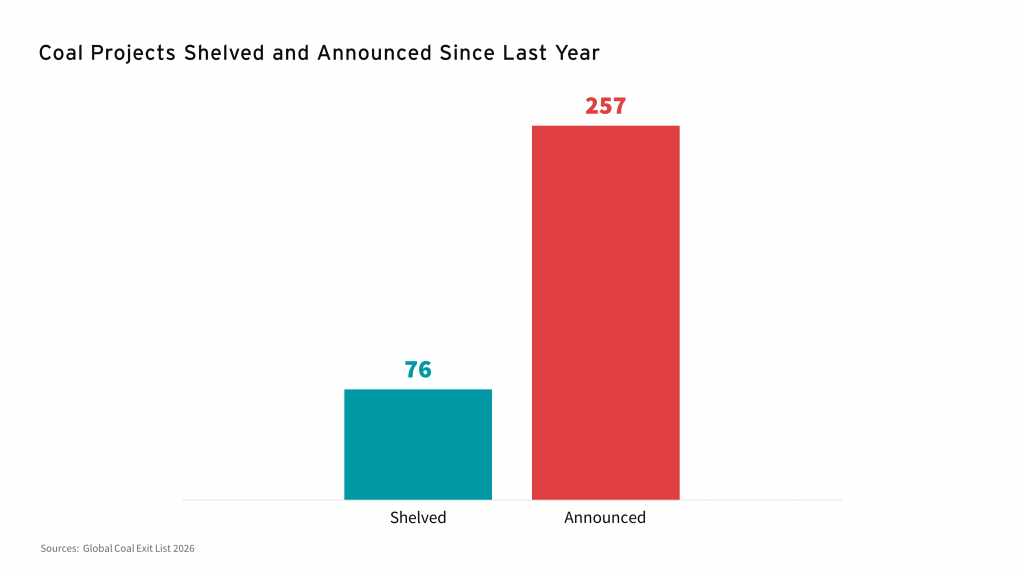
October 20, 2026 - As Australia and Türkiye prepare to co-host COP 31 in Antalya, Urgewald released the annual update of the “Global Coal Exit List” (GCEL). GCEL is the most comprehensive public database of companies operating across the thermal coal value chain, covering more than 1,500 parent companies and 1,150 subsidiaries. Currently, 717 financial institutions use GCEL to monitor and restrict financing for the thermal coal industry. GCEL 2026 can be downloaded at https:// coalexit.org. While 76 planned coal projects were shelved or cancelled in 2025, 257 new coal projects were announced over the past year. “For every shelved project, three new projects were announced,” says Pacôme David-Mauduit, senior researcher at Urgewald. “Instead of shrinking, the pipeline of new coal mining, power, chemicals and infrastructure assets under development has now grown to 1,510 projects. Over 40% of the companies listed on GCEL are currently developing new thermal coal assets,” he warns.
 Coal Power Expansion
GCEL 2026 identifies 335 coal power developers. Collectively, these companies are planning 606 new coal-fired power projects with a combined capacity of over 740 GW – an amount four times the size of the current US coal plant fleet. The world’s largest coal power developer is the China Energy Investment Group which aims to build 44 GW of new coal-fired capacity. All in all, Chinese companies are responsible for 70% of the global coal plant pipeline. Next in line are Indian companies, which account for 18%. The remaining 12% are spread out over 33 countries, one of which is Türkiye, host of COP 31.
Coal Is Still King in Türkiye
In large parts of Europe, wind and solar have surpassed electricity generation from coal, yet Türkiye still lags behind. Together, solar and wind accounted for 22% of Türkiye’s electricity generation in 2025, but coal remained the country’s dominant energy source, accounting for 34% of generation.
Although many proposed coal projects were canceled in Türkiye over the past years, the government remains determined to expand the Af?in-Elbistan coal power station. While a court recently overturned the Environmental Impact Assessment for new units at the Af?in-Elbistan power plant, the ruling is being appealed by the Ministry of Environment, Urbanization and Climate Change, which is led by COP 31 President Murat Kurum.
In June 2026, a further coal power project was announced by Cenal Elektrik, a subsidiary of the conglomerate Cengiz Holding. Cenal Elektrik plans to build a new 1,050 MW unit at its Cenal power station in Çanakkale. The proposal would effectively create a second large coal-fired power station, extending pollution and dependence on imported coal for decades to come. “The Cenal plant already burns over 3 million tons of coal each year. It pollutes the air we breathe and ruins the health of our children. It pollutes the coastal waters and agricultural lands our communities rely on,” says Süheyla Do?an of the Kazda?? Natural and Cultural Heritage Protection Association. “We will fight to the end to prevent the construction of a new coal unit.” Adding 1,050 MW to Cenal power plant would make Cengiz Holding the company with the third largest coal power capacity in Türkiye, with a total of 2,382 MW of coal power. Currently, the three companies with the largest coal power capacity are Eren Holding AS with 2,790 MW, Celikler Holding with 2,530 MW, and Elektrik Uretim AS with 1,804 MW.
The Turkish government has put electrification at the center of its agenda for COP 31, but it continues providing over €2.4 billion annually in subsidies to the coal industry. “Electrification without phasing out coal is like showering with polluted water. You can’t build a clean energy future on a dirty foundation,” comments Heffa Schücking, Director of Urgewald. “Türkiye's reliance on imported fossil fuels leaves our already vulnerable economy exposed to fossil fuel crises,” says Duygu Kutluay from Beyond Fossil Fuels. “By making a commitment to no new coal alongside a just transition plan for a coal phase-out, Türkiye can demonstrate meaningful climate leadership during its COP 31 Presidency.”
Russia’s Coal Industry in Crisis
Most of the coal burned in Turkish power plants is sourced from Russia. Russia’s coal industry has been hammered by the sanctions that followed the country’s invasion of Ukraine, but the causes of its decline are also structural. A report from Green Think Tank highlights how the impacts of sanctions were heightened by the structural deficiencies of Russia’s coal industry such as high transportation costs, high waste, dependence on foreign mining equipment manufacturers and reliance on government subsidies. After European sanctions led to the loss of Russia’s most important coal export market, the country’s coal industry was able to redirect its exports, but not to recoup its profitability. According to Russia’s Deputy Energy Minister, Dimitry Islamov, coal export profitability fell from 21% in 2023 to 3% in 2025.
Among the companies that have seen a sharp decline in revenues is Mechel PJSC, one of Russia’s leading coal miners. This year, the company suspended its Olzherasskaya-Novaya coal mine in the Kuzbass region, specifically naming lack of profitability as the reason.
According to news reports, this was one of around 20 mines in the coal-producing Kuzbass region which has closed since 2025. Meanwhile, Mechel is still attempting to increase coal shipments through its Eastern port of Posyet. Several of the country’s coal infrastructure projects have, however, run into trouble. The North-Siberian Railway project, meant to transport coal from Kuzbass to Eastern ports for export to East and South-East Asia, was cancelled by Russian authorities in December of 2025. Six further coal infrastructure projects also seem to have been shelved. Today, the largest importers of Russian coal are China and India, followed by COP 31 host Türkiye, which has received 15% of Russia’s coal exports since December 2022. “Through its coal imports, Türkiye’s power sector is throwing a financial lifeline to Putin’s regime and its brutal war against Ukraine. The quickest way to end this war is to cut Russia’s sources of income,” says Vladimir Slivyak, Co-Chair of the Russian NGO Ecodefense.
Coal Mining Expansion
GCEL 2026 identifies 357 coal mine developers that are opening up new thermal coal mines or expanding existing mines across 39 countries. Coal India is both the world’s largest thermal coal producer – producing 710 Mt in the last financial year– as well as the world’s largest coal mine developer with up to 552 Mtpa of new thermal capacity in the pipeline. In total, companies on GCEL plan to develop coal mining projects with a combined capacity of at least 3,271 Mtpa, equal to 41% of the world’s current thermal coal production.
Out of the 715 thermal coal mine expansion projects identified by GCEL, 251 are in China and 218 in India. While most of these projects are being developed for the power sector, the coal-to-chemicals industry has also become an important driver of coal mine expansion in both countries. To give an example: Until recently, the Sha’erhu District in Xinjiang only had active plans to develop one small 5 Mtpa mine. But this year, the local government decided to supply newly announced coal-to-chemical projects nearby, and now the district has four mining projects with a total planned capacity of 290 Mtpa. Within the last year, China’s planned coal-to-chemical development increased from 42 to 76 projects.
Australia’s COP Leadership Tarnished by Massive Coal Mine Expansion Plans
Ironically, the country with the third largest pipeline of thermal coal mining projects will be leading the negotiations at COP 31. Australia is the world’s second-largest coal exporter and currently has 49 new thermal coal mines or mine extensions planned, 20 of which are greenfield mines. Australia’s top three coal mine developers are: Adani Enterprises (45 Mtpa), Whitehaven Coal (19 Mtpa) and Banpu Public Company (7 Mtpa).
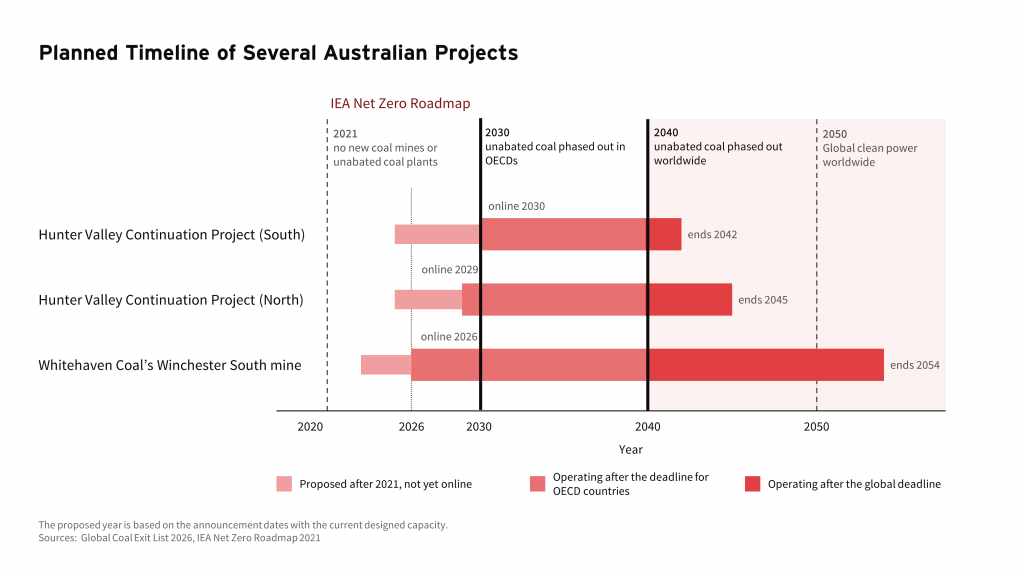 One of Australia’s largest coal projects – the Hunter Valley Operations Continuation Project – was approved on September 30th 2026, by the New South Wales (NSW) government. Hunter Valley Operations (HVO) is a joint venture of Yancoal Australia (51%) and Glencore (49%). It plans to expand two existing open-cut coal mines and extend their lifetime to as late as 2045. During this period, approximately 429 million tons of coal would be extracted from the two mines.
The project’s final approval, however, rests with Australia’s federal government. It will soon decide whether HVO must adhere to its original closure dates of 2026 and 2030, or can continue mining coal for another generation. Civil society organizations from across Australia have called for a moratorium on coal expansion, and during one of the many protests in NSW, parents lined up before the state parliament with photos of the children whose future will be impacted. As the Climate Councillor and former Commissioner of Fire and Rescue NSW, Greg Mullins, says, “What we export as coal, we import back as bush fires, floods, heatwaves and droughts. Climate harm does not stop at the border and neither does the responsibility for it.”
On 7 October 2026, Australia’s High Court issued a landmark judgment on the planned extension of another open-cut coal mine in NSW – the Mount Pleasant mine operated by Mach Energy. The court found that the project’s permit was invalid as NSW’s authorities had failed to take the mine’s Scope 3 emissions into account when approving the extension of its lifetime to 2048. The ruling clarifies that authorities can no longer ignore the emissions caused by burning coal overseas when considering mine expansion projects.
At COP 30, Australia signed the Belém Declaration, recognizing the need to transition away from fossil fuels and supporting the creation of a phase-out roadmap, but it is one of the few OECD countries that has failed to set an actual coal phase-out date. “The real proof of Australia’s climate leadership is not in its speeches at COP 31, but in its actions at home. That’s what the world will be watching,” says Schücking.
95% of the Coal Industry Still Has No Phase-Out Plan
According to the International Energy Agency, transitioning to a net-zero energy system by 2050 requires a phase-out of thermal coal usage by 2030 in advanced economies and by 2040 globally. Up to now, however, only a small minority of companies on GCEL have publicly committed to phasing out their coal assets.
Of the over 2,700 parent companies and subsidiaries on GCEL, only 142 have set phase-out dates for all of their coal assets. Five companies, in fact, dropped their coal phase-out plans this year, including Grand River Dam Authority in the USA and PT Cirebon Electric Power in Indonesia. Twelve companies have delayed their coal phase-out, although most of these were not aligned with the 2030/2040 deadline to begin with. Since last year, only 17 companies have effectively phased out their coal assets and were therefore removed from GCEL. Of these companies, 6 are headquartered in the USA and 2 in the Czech Republic. Chile, Japan, India, Bulgaria, Brazil, Hungary, Thailand and Malaysia each have 1 company which phased-out coal.
Although the coal industry is rapidly losing ground as new solar, wind and battery storage capacity comes online, the overwhelming majority of companies on GCEL have neglected to adopt coal phase-out plans and are ill-prepared for a transition. They should take note of the warning issued by Frank Elderson, member of the European Central Bank’s Executive Board, on transition risks: “Failing to prepare is preparing to fail.”
More and More Financial Institutions Turn Away from Coal
Financial institutions provided much of the capital that enabled the coal industry’s enormous growth over the past decades. By the same token, financial institutions now have the power to hasten the world’s exit from coal.
Today, over 400 large financial institutions have adopted coal restriction policies. Out of these, 130 policies explicitly exclude financing, investment and insurance of coal developers and 183 policies set firm dates for phasing coal out of financial portfolios. Where strong policies exist, these have real and measurable impact. According to research Urgewald published in September 2026, EU banks, for example, cut their coal financing by 46% in the last four years. And coal financing by banks from Malaysia, Thailand and Taiwan fell even further.
“It is high time for other financial actors to follow suit and for financial regulators to take action. Rising temperatures confirm that we can’t let coal linger,” says Schücking.
|








|