








|
Signature Sponsor


October 21, 2026 - Lynchburg, VA-based Innovative Wireless Technologies, a developer of advanced wireless technology, and Virginia Tech are part of a $73 million U.S. Department of Energy mining tech initiative.
The four-year project has a $25 million funding allocation, with about $17.7 million expected to come from federal funding and the balance from matching contributions by IWT and its project partners, according to a Sept. 9 news release from IWT. Virginia Tech expects to receive about $4.6 million of that funding, according to its release.
Called Mine of the Future, the DOE program aims to establish domestic testing grounds for mining technologies as the United States works to strengthen its domestic critical mineral supply chain.
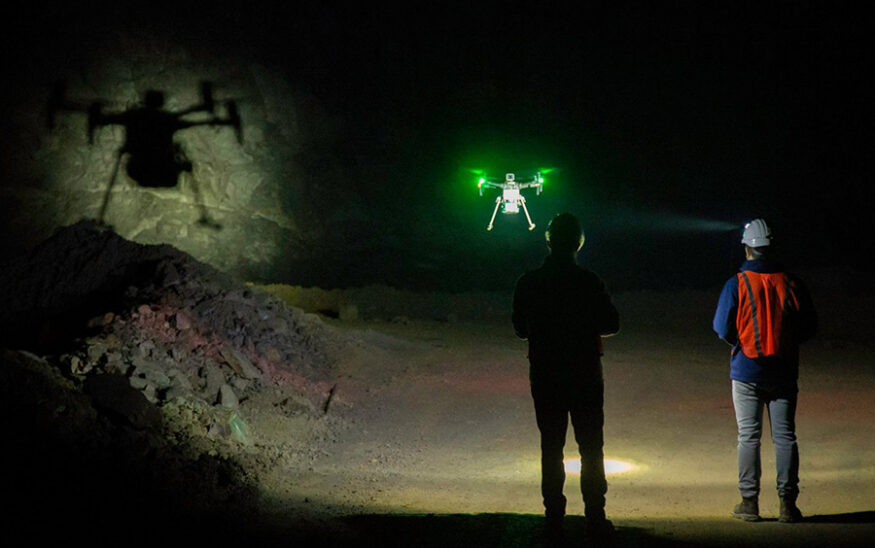
A modular autonomous drone flies in an underground mine. Photo by Richard Bishop, courtesy Virginia Tech
As part of the initiative, IWT will work to develop a national proving-ground framework for testing wireless, tele-remote and other advanced mining technologies in underground and surface mining environments, according to a Thursday news release from Virginia Tech.
“The Mine of the Future closely aligns with IWT’s technology roadmap and our vision for an increasingly intelligent, data-driven mining environment,” IWT CEO Eric Hansen said in the firm’s Sept. 9 release. “This project provides an opportunity to accelerate that vision while working alongside government, industry and research leaders to advance technologies that strengthen operational awareness, improve safety and support the competitiveness of U.S. mining.”
Founded in 1997, IWT develops technology for commercial, industrial, defense, mining and tunneling environments.
At Virginia Tech, researchers in the Bradley Department of Electrical and Computer Engineering and the Department of Mining and Minerals Engineering will work to move emerging technologies from the laboratory into mining environments, according to the release.
Electrical and computer engineering researchers will focus on wireless networks that connect mines, while mining and minerals engineering experts will work at the Virginia Tech Quarry in Blacksburg to develop a surface mining proving ground.
“This project brings together two areas where Virginia Tech has truly world-class capabilities: wireless communications and mining engineering,” Virginia Tech Professor Aaron Noble, head of mining and minerals engineering and interim department head of materials science engineering, said in the release. “By combining those strengths, we can help innovate the mine of the future while fulfilling our land-grant mission to turn discovery into practical solutions that serve industry, communities and the nation.”
IWT will lead the work. In addition to Virginia Tech, partners include the Colorado School of Mines, the West Virginia Training and Conference Center, the University of Kentucky, Device Solutions, a North Carolina-based product development engineering firm; and Phillips Global, a West Virginia mining equipment company.
For the initiative, Nishith Tripathi, a Virginia Tech associate professor in electrical and computer engineering and a principal investigator with Mine of the Future, will design and refine wireless communication systems based on 5G and 5G-Advanced technologies, emphasizing reliability, low latency and efficient power use. He will also lead efforts to measure how wireless signals behave in mining environments and use that data to improve network performance.
“Unlike wireless networks on the surface, where radio signals can travel relatively predictably between smartphones and cellular towers, mines can extend hundreds of meters underground and present very different conditions for wireless signals,” Tripathi said in the release.
Tripathi will work with Jeff Reed, a professor of electrical and computer engineering, and Harpreet Dhillon, the W. Martin Johnson Professor of Engineering and associate dean for research and innovation in Virginia Tech’s College of Engineering.
Reliable wireless systems support automation in mines, according to Virginia Tech.
“Autonomous vehicles and robots need to communicate with their controllers, and those commands need to reach the autonomous vehicles and robots very quickly and be received correctly,” Tripathi said in the release.
The mining portion of the project will be led by Virginia Tech Assistant Professor Rohit Pandey and will use the Center for Autonomous Mining Systems, or CAMS, and the Virginia Tech Quarry as proving grounds for tele-remote and autonomous equipment, wireless testing and training. Researchers will equip mining machinery with sensors and telematics and develop systems to help machines recognize people, equipment and terrain hazards. They will also create digital twins to help identify maintenance needs.
Pandey will work with Noble and Virginia Tech Professor Emily Sarver, an expert in respirable mine dust characterization and monitoring.
Another goal of the initiative is to advance real-time monitoring of slurry pipelines used to move clay-rich rare earth ores and to boost workforce development through collaborative research and hands-on training and certification programs, according to Virginia Tech.
“A technology that works in the lab is not the same as one that works on a mine site with dust, vibration, uneven ground and people working nearby,” Pandey said in the release. “The CAMS and the Virginia Tech Quarry lets us close that gap on real equipment, and putting wireless engineers and mining engineers on the same team means the network gets designed around what the machines and the workers actually need.” |








|