









|
Signature Sponsor

October 22, 2026 - Assistant Secretary of Energy Audrey Robertson walked through Virginia Tech’s Holden Hall on October 21, 2026, to see something most energy officials never get close to: the software and robotics stack that is quietly rewriting how coal, lithium, and rare-earth mines get run. The visit, first reported by WDBJ7, put a Department of Energy spotlight on a $73 million federal initiative called Mine of the Future, and on a piece of code-and-sensor infrastructure that looks a lot more like a DevOps pipeline than a pickaxe.
For a general tech audience, the headline might read like a regional story about a university lab tour. For anyone tracking where autonomous systems, wireless networks, and digital-twin software are actually shipping into revenue-generating industrial settings, it is a data point in a much bigger trend: mining is becoming a software problem, and the federal government just put real money behind proving it.
What happened at Virginia Tech on October 21
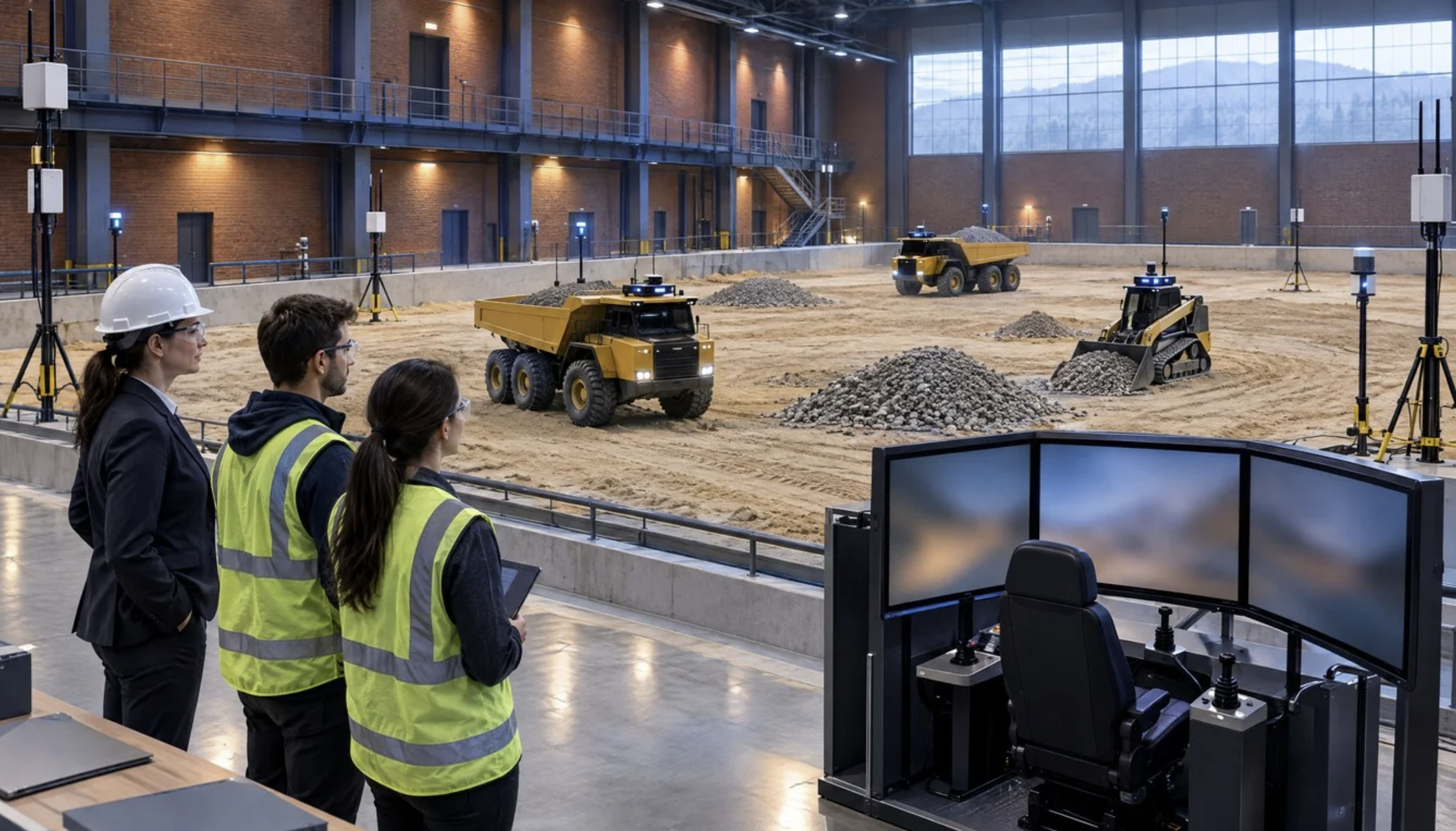
According to WDBJ7’s on-the-ground report, Robertson toured two specific facilities inside Virginia Tech’s mining engineering program: the Autonomous Mining Arena and the Equipment Simulation Lab. Virginia Tech is one of just 14 accredited mining schools left in the United States, a figure that undercuts just how concentrated this slice of engineering education has become even as demand for the minerals it produces keeps climbing.
The visit was not a courtesy call. It was staged to showcase progress on Mine of the Future, a Department of Energy initiative that Virginia Tech News confirms is funded at $73 million and designed to modernize how domestic mining operations handle equipment, labor, and data. The DOE’s interest is not academic curiosity. It is tied directly to a federal push to secure the mineral supply chains that feed semiconductor fabs, EV battery plants, and defense manufacturing, all of which depend on materials the United States currently imports or under-produces.
Robertson framed the stakes in blunt terms. As she put it, “Over 90% of the critical minerals in the world are processed in one country. And we need those critical minerals for really our modern way of life, from your cell phone to our national defense.” That line, delivered inside a university robotics lab rather than a policy briefing room, is the clearest signal yet that Washington treats mining automation as a national security software problem, not a niche industrial upgrade.
Inside Mine of the Future: who is building it and with what money
The $73 million DOE initiative is not a single grant to Virginia Tech. It is a broader program, and one of its lead contractors is Innovative Wireless Technologies Inc. (IWT), a Lynchburg, Virginia-based technology company. Virginia Business reports that IWT is leading a $25 million slice of the broader program, with Virginia Tech expected to receive roughly $4.6 million of that allocation to support its share of the research.
The project is structured to run four years, with about $17.7 million of the funding coming from federal sources and the remainder covered by matching contributions from IWT and its partners. That cost-share structure is standard for DOE applied-research grants: it forces private industry to have skin in the game rather than treating federal dollars as pure subsidy.
The research itself spans a stack that will look familiar to anyone who has worked on industrial IoT or autonomous vehicle software: wireless networks built for underground and open-pit conditions, tele-remote equipment operation, fully autonomous equipment, sensor networks, telematics, hazard recognition systems, and digital twins used for predictive maintenance.
Rohit Pandey, an assistant professor of mining and minerals engineering at Virginia Tech, is serving as the project’s mining lead, overseeing testing at both the Virginia Tech Quarry and the university’s Center for Autonomous Mining Systems (CAMS).
Why a mining story belongs in a tech conversation
It is tempting to file this under regional economic development news and move on. That would miss the point. The research areas named in the DOE-backed project (wireless networks, autonomous equipment, sensors, telematics, hazard recognition, digital twins) are the exact same categories of engineering work driving investment in self-driving trucks, warehouse robotics, and industrial AI elsewhere in the economy. Mining is simply one of the harder environments to deploy that stack into, because underground and open-pit sites lack reliable connectivity, GPS, and the kind of controlled lighting that autonomous vehicle companies take for granted on public roads.
That is also why wireless infrastructure sits at the center of the IWT-led project rather than being treated as plumbing. Autonomous or tele-remote mining equipment is useless without a wireless network that can survive rock, dust, and constantly shifting tunnel geometry. Readers who have followed how carriers are rebuilding radio access networks around AI, such as the carrier moves covered in T-Mobile’s AI-RAN call pulling in three more carriers and Nvidia and Nokia’s AI-RAN push reaching nearly 20 telcos, will recognize the same underlying challenge: getting intelligent, low-latency wireless coverage into environments that were not designed for it.
The autonomous equipment and tele-remote operation pieces of Mine of the Future also track closely with work happening in adjacent industrial sectors. Nvidia’s push to put its Alpamayo foundation model into commercial trucking, detailed in coverage of Einride putting Nvidia’s 32-billion-parameter Alpamayo AI into trucks, is solving a version of the same problem: giving heavy equipment enough situational awareness to operate with reduced or no human intervention in unstructured terrain. Lincoln Electric’s move into AI-driven robotic programming, covered in Lincoln Electric’s XpertLINC eliminating manual robot code, shows the same shift toward “physical AI” that lowers the skill floor needed to operate complex machinery, a direct parallel to what Mine of the Future is attempting with hazard recognition and predictive maintenance systems.
The critical minerals angle: why the DOE is spending here now
Robertson’s 90% figure on mineral processing concentration is the policy hook that explains the timing of this spending. The United States has spent the past several years watching semiconductor, battery, and defense supply chains get exposed as dependent on a small number of foreign processing hubs. Mine of the Future is one piece of a broader federal strategy to rebuild domestic capacity, not by throwing more labor at mining, but by making the labor that exists dramatically more productive through automation, remote operation, and predictive software.
That strategy has an obvious industrial-policy parallel in chip manufacturing, where federal and state dollars have chased capacity expansion for years. Amkor’s decision to triple its investment in a Gwangju packaging facility, covered in Amkor tripling its Gwangju bet to $2.3 billion, reflects the same underlying logic applied to semiconductor packaging: the US and its allies are willing to subsidize domestic or allied capacity in materials and components deemed strategically important, even when the unsubsidized economics might favor concentrating that capacity elsewhere.
The workforce dimension matters just as much as the technology dimension here. With only 14 accredited mining schools left in the US, the talent pipeline for running, let alone automating, domestic mining operations has been shrinking for decades. Robertson’s framing (building “a career for decades” around mining innovation) is as much a recruitment pitch for engineering students as it is a technology announcement. Programs like Mine of the Future function as both R&D investment and workforce-development marketing, aimed at convincing computer science, robotics, and electrical engineering graduates that mining is a legitimate destination for their skills rather than a dying industry.
How this compares to other federally backed autonomy programs
Mine of the Future is small by the standards of federal technology spending. $73 million is a rounding error next to the hundreds of billions big tech companies are pouring into AI infrastructure, a gap explored in coverage of how Tesla’s $20 billion AI plan trails big tech’s roughly $750 billion in combined spending. But the comparison is not really about scale. It is about where public and private capital are willing to underwrite the risk of deploying unproven autonomy in physically dangerous environments.
Private capital has shown a similar appetite for funding general-purpose robot autonomy, just outside of mining specifically. Dream Labs’ $90 million seed round for an any-robot foundation model, covered in Dream Labs raising $90 million for a cross-platform robot AI model, is chasing a horizontal version of what Mine of the Future wants vertically inside mining: a software layer that lets physical equipment operate with less constant human supervision. The difference is that Dream Labs is venture-funded and aimed at broad commercial deployment, while Mine of the Future is grant-funded, narrowly scoped to mining, and explicitly tied to a national-security mineral strategy rather than a product roadmap.
The research stack, piece by piece
Breaking down the research areas named in the DOE announcement gives a clearer picture of what engineers are actually building inside Virginia Tech’s labs, and why each piece matters for the broader goal of a safer, more productive mine.
Every one of these categories already has a commercial analogue running somewhere else in the economy today. What Mine of the Future is really funding is the translation layer: taking proven digital twin, sensor, and autonomy approaches from other industries and hardening them for the specific physics of underground and open-pit mining, where connectivity, visibility, and terrain are far less forgiving than a warehouse floor or a highway.
Market impact: what this means for industrial tech vendors
The most immediate commercial winner from a program like Mine of the Future is likely to be the vendor ecosystem supplying ruggedized wireless infrastructure, not the mining operators themselves. IWT’s position as lead contractor on the $25 million sub-project gives it a federally validated reference deployment it can point to when pitching other mining operators, utilities, or even tunnel-construction firms that face similar connectivity problems. That is a meaningful credibility boost for a mid-sized Lynchburg firm competing against larger industrial automation vendors with far bigger marketing budgets.
Sensor and telematics suppliers stand to benefit in a similar way. Hazard recognition and predictive maintenance systems depend on dense networks of environmental and equipment sensors, the same category of hardware that has seen rapid cost declines as edge AI chips get smaller and cheaper. That cost curve is part of why automation that was economically unworkable in underground mining a decade ago is suddenly viable: sensors, compute, and wireless radios have all gotten cheaper at the same time the DOE decided critical-mineral security was worth subsidizing. Chipmakers chasing edge AI deployments in harsh industrial environments, including the kind of low-power inference hardware covered in reporting on Google and Synaptics shipping AI chips for edge devices, are indirectly competing for a slice of this same demand curve, even though neither vendor was named as a direct participant in the Virginia Tech project.
There is also a quieter effect on university technology-transfer pipelines. Virginia Tech’s Center for Autonomous Mining Systems now has a federally funded reason to keep publishing research and filing patents around autonomous equipment control and digital twin modeling specific to mining conditions. Over a four-year project window, that typically produces spinout companies, licensing deals, or at minimum a cohort of graduate researchers who become the next generation of hires for IWT and its competitors. Federal mining-automation money, in other words, is also indirectly funding a talent factory that the private sector gets to draw from without bearing the full R&D cost itself.
Risks and open questions the announcement does not answer
None of the reporting on Robertson’s visit addresses cost or timeline risk in detail, and that gap is worth flagging rather than filling in with speculation. A four-year applied-research project with a mixed federal and private funding structure can slip on schedule for reasons that have nothing to do with the underlying technology, from permitting delays at test sites to turnover among the graduate researchers doing the hands-on engineering work. Virginia Business and Virginia Tech News both describe the funding structure and research scope clearly, but neither outlet reports a specific completion date beyond the general four-year window, nor do they detail what happens if the autonomous equipment or hazard recognition systems underperform expectations during testing at the Virginia Tech Quarry.
There is also an open question about how this program interacts with mine safety regulation. Autonomous and tele-remote equipment introduces a different risk profile than traditional operator-controlled machinery, and federal mine safety regulators have historically moved slowly on certifying new equipment categories. None of the available reporting indicates whether the Mine of the Future research track includes a regulatory approval pathway alongside the engineering work, which could end up being the longer pole in the tent for actual commercial deployment, regardless of how well the technology performs in controlled test conditions.
Historical context: mining automation did not start in 2026
Mining has flirted with automation for decades, mostly in the form of remote-controlled drilling and haulage equipment deployed by large mining companies in Australia and Canada starting in the 2000s and 2010s. What is different about Mine of the Future is the explicit framing around federal industrial policy and critical-mineral security, rather than pure operating-cost reduction. Earlier waves of mining automation were driven by mining companies trying to cut labor costs and improve safety metrics on their own balance sheets. This wave is driven by a government that has concluded domestic mineral processing capacity is now a national security variable, not just a line item on a mining company’s income statement.
That shift matters for how durable this kind of funding is likely to be. Industrial policy driven by national security concerns tends to survive budget cycles and administration changes better than programs justified purely on economic efficiency grounds, because the underlying strategic rationale (reducing dependence on a single country for minerals that feed semiconductors, batteries, and defense systems) does not go away when interest rates or commodity prices shift.
What to watch next
Several threads from this visit are worth tracking over the next year as the four-year IWT-led project gets underway.
The bigger picture for tech workers and engineers
For software engineers, robotics specialists, and wireless network engineers who assume their skills belong exclusively in Silicon Valley or big tech data centers, Mine of the Future is a reminder that federally funded industrial automation is quietly becoming a real employer in a field most tech workers never consider. The same expertise that goes into building AI-RAN networks for telecom carriers, training foundation models for warehouse robots, or writing predictive maintenance software for data center hardware applies almost directly to the research categories Virginia Tech is testing: wireless networks, sensors, telematics, hazard recognition, and digital twins.
Robertson’s pitch to students, that mining innovation can be “an area where you can thrive and build a career for decades,” is also an implicit acknowledgment that the talent pool is thin. With only 14 accredited mining programs left nationally, the DOE and companies like IWT have a direct interest in making mining engineering look less like a legacy trade and more like an extension of the same autonomy and AI work happening everywhere else in tech. Whether that pitch lands with the next generation of robotics and software graduates may matter as much to the success of Mine of the Future as the $73 million itself.
Frequently asked questions
What is the Mine of the Future initiative? It is a $73 million Department of Energy program designed to modernize US mining operations through autonomous equipment, wireless networks, sensors, telematics, hazard recognition systems, and digital twins, according to Virginia Tech News.
Who leads the Virginia Tech-connected project under Mine of the Future? Innovative Wireless Technologies Inc. (IWT), a Lynchburg, Virginia-based technology company, leads a $25 million project within the broader initiative, with Virginia Tech expected to receive about $4.6 million, per Virginia Business. How long will the IWT-led project run? Four years, with roughly $17.7 million expected to come from federal funding and the remainder from matching contributions by IWT and its project partners. What facilities did Assistant Secretary Audrey Robertson visit? She toured Virginia Tech’s Autonomous Mining Arena and Equipment Simulation Lab inside Holden Hall on October 21, 2026, according to WDBJ7. Who is overseeing the mining side of the research at Virginia Tech? Rohit Pandey, an assistant professor of mining and minerals engineering, is the project’s mining lead, with testing conducted at the Virginia Tech Quarry and the Center for Autonomous Mining Systems (CAMS). Why is the Department of Energy funding mining automation research? Robertson tied the funding directly to critical mineral security, noting that over 90% of the world’s critical minerals are processed in a single country, creating supply chain risk for everything from consumer electronics to national defense. How many accredited mining schools exist in the United States? Only 14, according to WDBJ7’s reporting on the Virginia Tech visit, underscoring how narrow the domestic talent pipeline for mining engineering has become.
Does this program overlap with other autonomous vehicle or robotics funding? Not directly in funding source, but the underlying research categories (autonomous navigation, tele-remote operation, sensor fusion, predictive maintenance) closely mirror work being funded separately in trucking, warehouse robotics, and industrial automation across the private sector. |






|