








|
Signature Sponsor


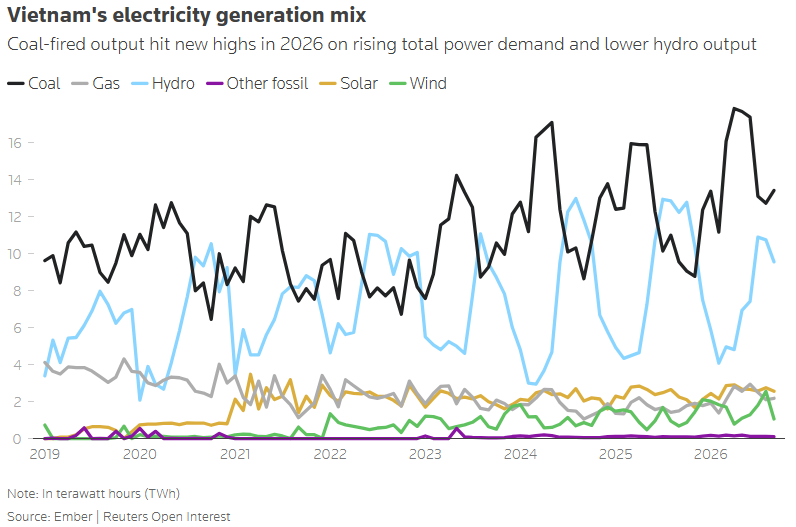
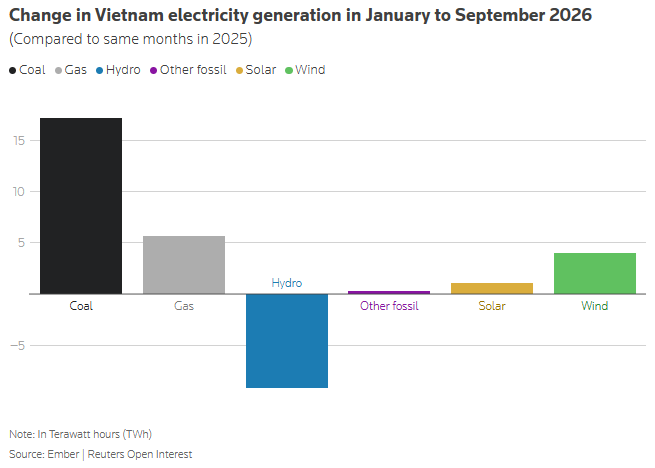
October 23, 2026 - A years-long trade war between the United States and China has helped shift manufacturing investment, factory output and export production into Vietnam, driving the Southeast Asian nation's coal-fired electricity generation to record highs. Vietnam's coal plants generated 132.9 terawatt hours (TWh) of electricity during the first nine months of 2026, which is a 15% jump from the same months last year and the highest for that period on record, according to data from Ember.
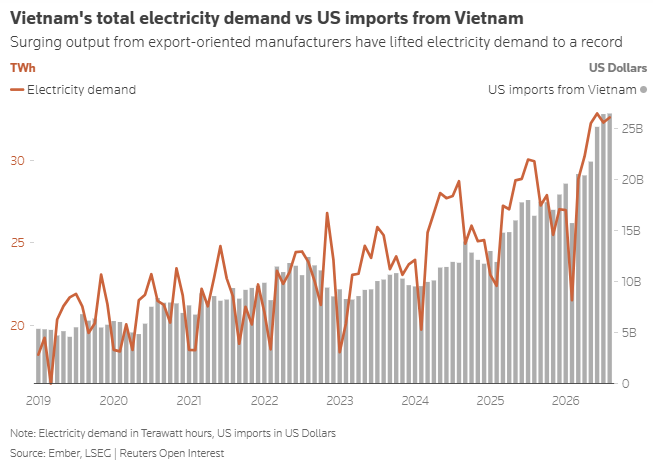
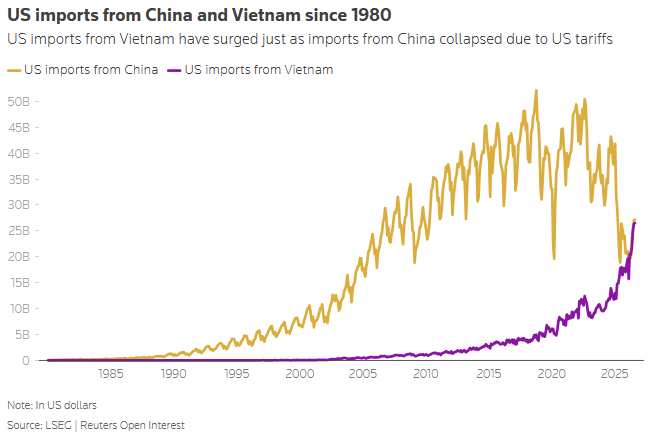
A roughly 12% decline in year-to-date hydro power production due to below-normal rainfall this summer has been a key driver of the greater coal-fired activity, forcing utilities to offset stunted reservoir output with higher coal production. But a larger factor has been the steady swell in Vietnam's export-oriented manufacturing sector, which has grown rapidly within the past decade and lifted the country's total electricity demand by nearly 50% since 2019. In many respects, that manufacturing expansion can be traced back to Washington. US tariffs on Chinese imports since 2018 encouraged manufacturers to diversify production into lower-cost locations, with Vietnam emerging as one of the biggest winners.
The shift has helped supercharge Vietnam's factory sector and power demand, but it has also tied an increasing volume of export production destined for the US market to a power system that still relies heavily on coal for electricity generation. America's Factory Floor The switch in production origins shows up clearly in US trade data. In 2018, US imports from China were roughly 10 times larger than imports from Vietnam. This year, monthly imports from the two countries have been nearly level.
When US imports from China hit their peak of roughly $539 billion, average monthly US trade flows to China were around $45 billion, data from LSEG shows. During that same year, average US monthly trade flows to Vietnam were around $4 billion. So far in 2026, average monthly US trade flows to China and Vietnam have been around $22.9 billion and $22 billion, respectively. That more than 400% rise in the value of Vietnam's monthly exports to the US helped fuel an economy-wide boom, with Vietnam's gross domestic product (GDP) posting an average annual expansion of 7.4% since 2022, according to the International Monetary Fund. That growth pace was one of the world's fastest during that period, and in turn triggered sustained growth in Vietnam's total electricity consumption, which expanded at an average rate of 6% a year between 2022 and 2025, data from Ember shows. Coal-Heavy Power Mix Vietnam's electricity system is heavily reliant on coal, with coal-fired power stations accounting for an average of around 49% of total utility supplies since 2019. By comparison, coal accounts for around a third of electricity generation globally, which means that Vietnam has a substantially more coal-dependent power system than most. However, coal's share of Vietnam's power mix can fluctuate significantly depending on the availability of alternative power sources in any given year. For instance, coal only accounted for 38.5% of the power mix in 2022 thanks to strong hydro production that year as well as a surge in international coal prices, which spurred nearly all cost-sensitive power systems to pare back coal use. So far in 2026, coal's share has averaged nearly 52% of the generation mix due to the lowest hydro production tally since 2023.
That coal share is the highest for that period since 2020, and has resulted in a 16% jump in power sector emissions to a record 129 million metric tons of carbon dioxide and equivalent gases so far this year, data from Ember shows. And with the peak hydro production period already passed, additional gains in both coal use and coal emissions are likely, which will help cement 2026 as a record for Vietnam's coal power reliance. Over the longer term, Vietnam does have significant non-coal power capacity under construction, including around 11 gigawatts (GW) of gas-fired power, 1.4 GW of new hydro capacity, and around 1.3 GW of wind capacity, according to Global Energy Monitor. But there are also an additional 2.7 GW of new coal plants being built, with a further 2.6 GW planned after that. That means that, having won a growing share of the US import demand, Vietnam looks set to primarily power that production with coal. That in turn may serve to keep the cost of goods production relatively low, but comes with its own climate price tag that US importers may have to wrestle with as and when their supply chains come under scrutiny. |








|