







|
Signature Sponsor


October 25, 2026 - Several emerging factors provide a long-term positive external environment for the global coal industry, but also, more specifically, for Peabody Energy (BTU). The recent rise in steel prices from lows experienced in August, the global LNG shortfall, and the increasingly insatiable demand for energy from the fast-expanding AI sector are all converging to make for a strong argument in favor of coal prices rising in the long run. In the shorter term, we do have the increasingly probable prospect of a global economic crisis, which should provide us with a more advantageous buying opportunity. In case I am wrong, I initiated a modest position with the intent to continue adding incrementally in the event that the stock does decline significantly from current levels.
Maintaining a Buy Position
The last time I covered Peabody, it was in May, at which point I initiated a position, in expectation of an opportunity to add more on further weakness. Except for a pullback in its share price in the summer, the stock mostly went in the opposite direction, at which point I decided to take profits by late August, with an eye on the Iran crisis lasting well beyond my expectations, which I see as a path to an eventual global economic crisis.
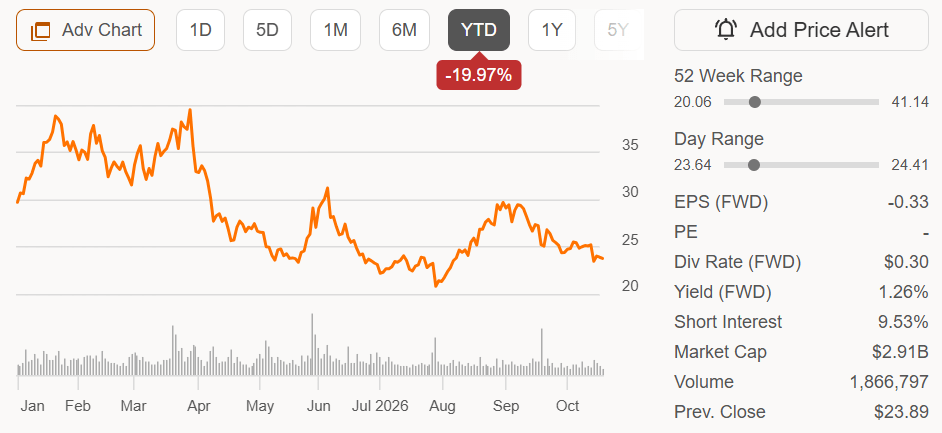
Peabody share price & other metrics. (Seeking Alpha.)
Between the recent retreat in its share price and improving long-term external fundamentals, it is emerging once again as a buying opportunity.
Rising Operating Costs Are Eating Into Profits
For the first six months of the year, Peabody saw an increase in revenues of 8%, to $1.98 billion compared with the same period in 2025. Operating expenses increased by 17% in that period, to $1.82 billion. This led to an earnings loss of $123 million in H1 2026, compared with a net income of just under $7 million in the corresponding period in 2025. The decline in profitability may be in part a reflection of the company's ramp-up phase of its Centurion project. We can probably expect to see a significant improvement in the company's profitability in the coming quarters as ramp-up costs start to subside, while revenues from Centurion increase.
Interest expenses increased just slightly in H1, 2026, to $23.4 million, which equates to about 1.2% of revenues. I regard this metric as an important reference point for a company's financial health. I see the threshold of interest costs taking up more than 5% of a company's revenues as a warning sign, suggesting that a vicious cycle could develop, where interest costs take up an excessive portion of a company's internal resources, leading to a spiraling deterioration.
The Emerging Global Energy Crisis Renews Interest in Coal as a Secure Source of Energy
The IEA estimates that global coal demand is set to increase by 1.2% this year. It is by no means a robust pace of growth, but prior forecasts showed and expected a decline for the year as part of a broader long-term trend. The rising costs of natural gas, in part due to the ME war but also due to the continued disruption of Russia's natural gas exports since 2022, provide the main catalyst for the reversal in longer-term global coal demand trends.
The rise in demand for electrical power around the world, driven by a combination of continued electrification of the economy, as well as a rise in the ranks of the global middle class, is, in my view, set to counter the factors that create downward pressure on coal demand. AI data centers, EVs, and other emerging demand patterns are making the global economy more reliant on electrical power.
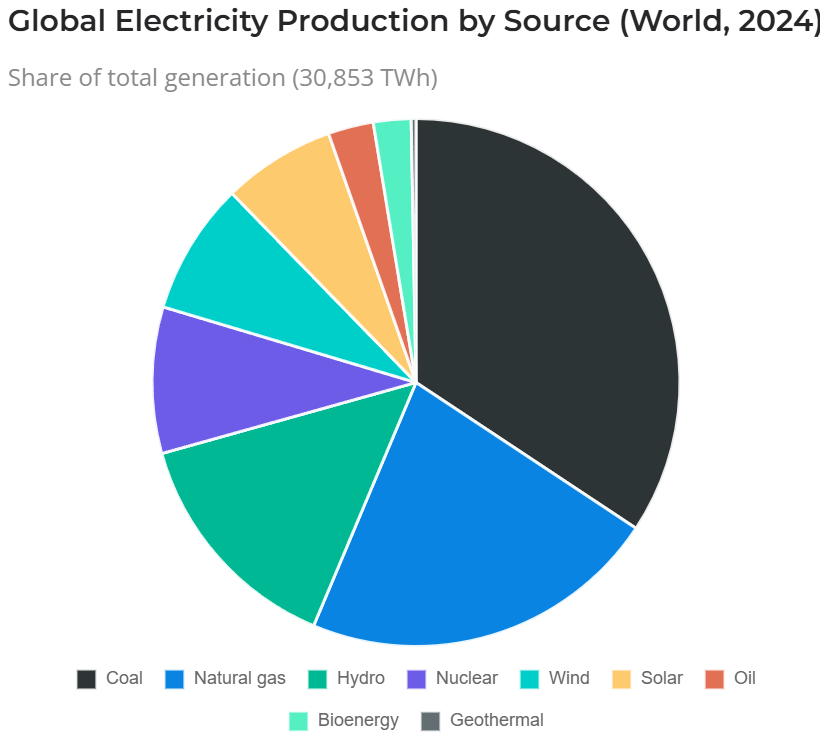
For much of the 21st century, it was assumed that renewables such as wind & solar would help to meet most of the rise in energy demand.
Globalelectricity.org.
By some estimates, coal could account for only about 1% of total global electricity generation capacity by about 2050. This is unlikely to be the case in my view. I believe that coal will continue to play an important role in global electricity generation for the rest of the century, as technical issues related to the intermittent, unreliable nature of the supposed replacement source, namely renewables, are being recognized.
My personal view is that we will enter a period of demand stagnation in coal that could potentially last decades. In countries & regions such as Europe, it is more than likely that coal demand will continue to decline. It might not decline as dramatically as expected, especially after the current decade, when high-energy prices have been the defining factor shaping the continent's economic and social evolution.
Metallurgical Coal Demand May Rise in the Long Term
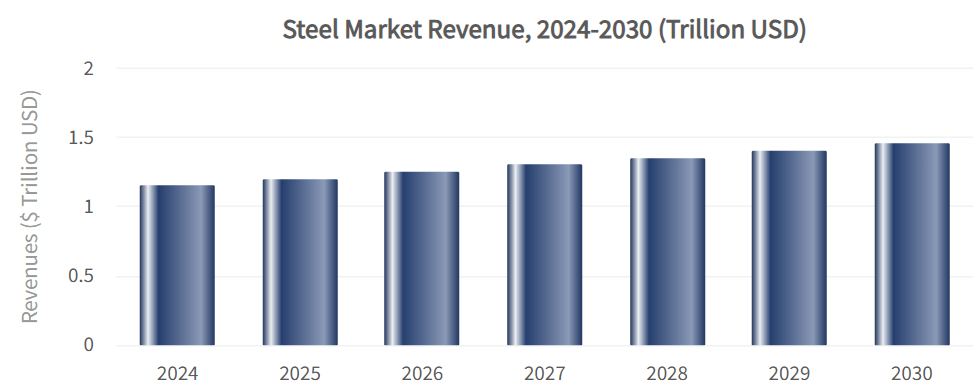
Metallurgical coal demand will be driven by global steel demand, which has a slightly different dynamic than thermal coal.
NMSC.
The forecast above for steel demand looks promising for the metallurgical coal market. As I have been writing recently, I expect to see a global energy crisis within the next few months, since the conflicts that caused the disruption of global energy supplies are nowhere near being resolved. As such, I believe that global steel demand will be significantly weaker than it is currently forecast.
Investment Implications
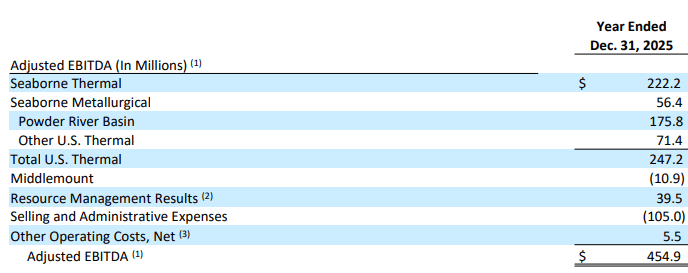
Looking at Peabody's company profile, within the context of external trends I described, I see this year's pullback in its share price as providing a good initial entry point.
Peabody.
If I am correct and an impending energy crisis will trigger a global demand destruction event, the initial effect on the coal market will probably be very negative. Thermal coal is likely to be less affected than metallurgical coal, since electricity demand is less cyclical than steel demand. Even though metallurgical coal plays a smaller role in the company's financial results, it may still lead to a sizable hit.
As is always the case, after a downturn, there will be an economic recovery, at which point I see both thermal & metallurgical coal doing well. Metallurgical coal demand growth will be driven by the need to produce building materials as the World will seek to adapt to new realities. Developing nations such as India, Indonesia, Vietnam, and the entire continent of Africa are still in much need of infrastructure and industrial development, so they will probably lead the way.
Thermal coal demand will be driven by the realization that in the short to medium term, other sources of electricity will fall short of demand growth. Nuclear power takes a long time to ramp up; wind & solar lack the ability to provide a steady supply, which can lead to grid instability. Natural gas supplies may not be as plentiful as assumed either. Many US shale fields are stagnating or declining, while sanctions continue to constrain Russian natural gas. Coal may not be a booming industry, but its demise may be prematurely heralded, while the markets are seemingly pricing in at least partial expectations of the industry continuing to shrink at a fast pace.
The significant decline in Peabody's share price this year, even as energy prices, including coal prices, are rising, is in many ways unexpected, if one only looks at external factors.
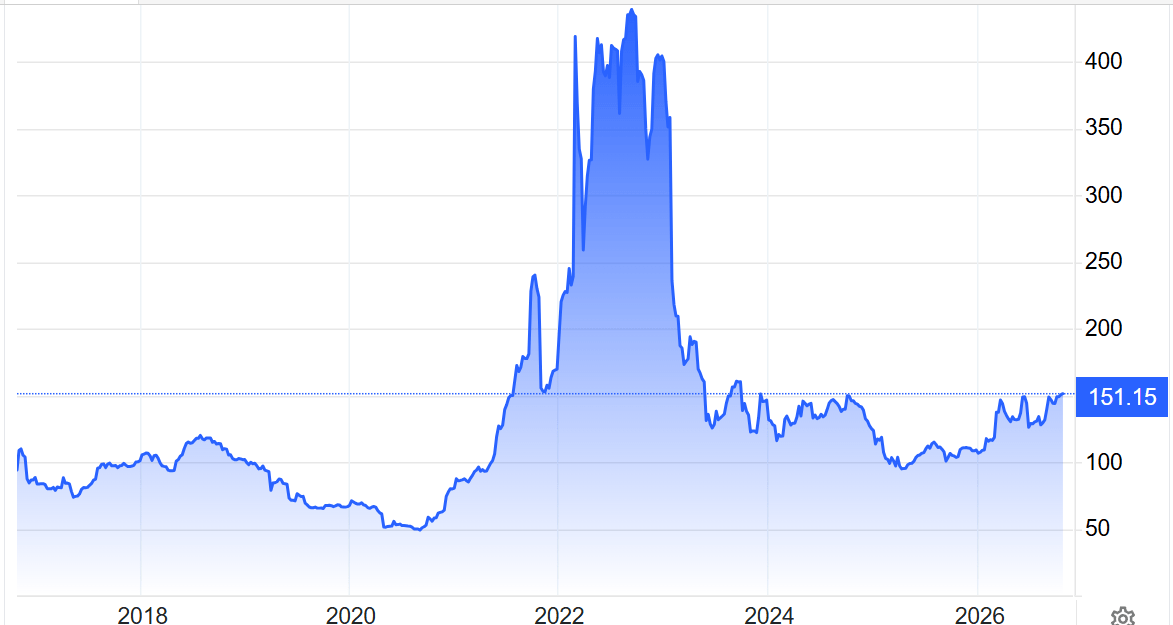
Thermal coal spot price. (Trading Economics.)
As the chart shows, coal prices are up over 40% YTD. The shape of the chart more or less resembles the European natural gas spot price market.
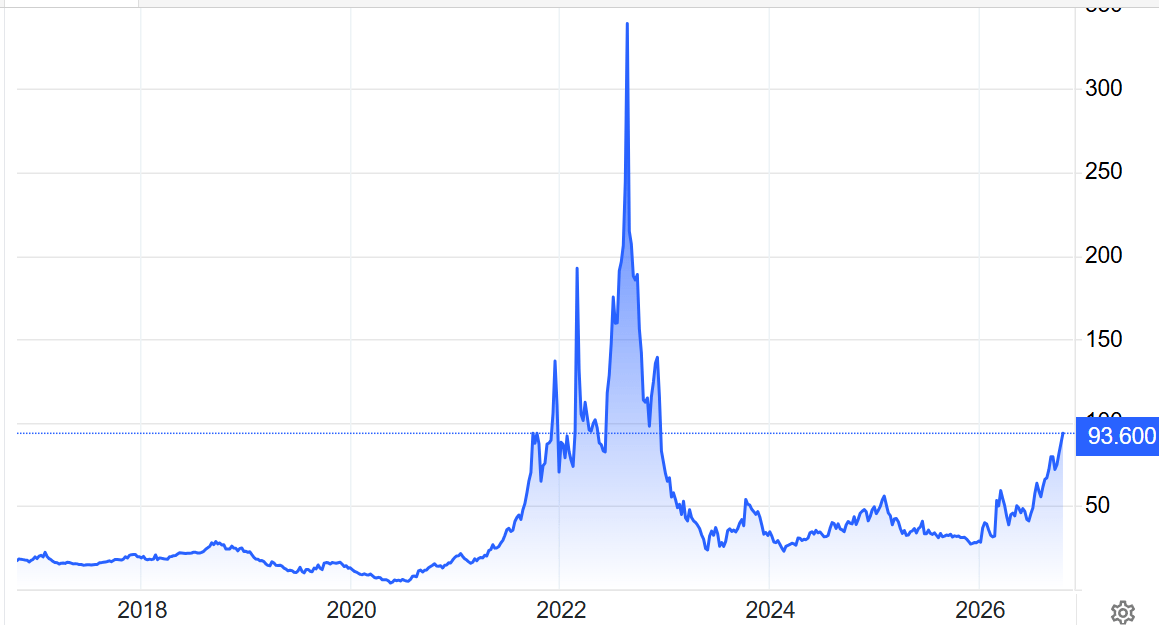
Europe TTF natural gas spot price chart. (Trading Economics.)
The main difference is that European natural gas spot prices are up about 3-fold so far this year. Nevertheless, one might expect Peabody's share price to trade in correlation with companies like Equinor (EQNR), Europe's largest natural gas provider.
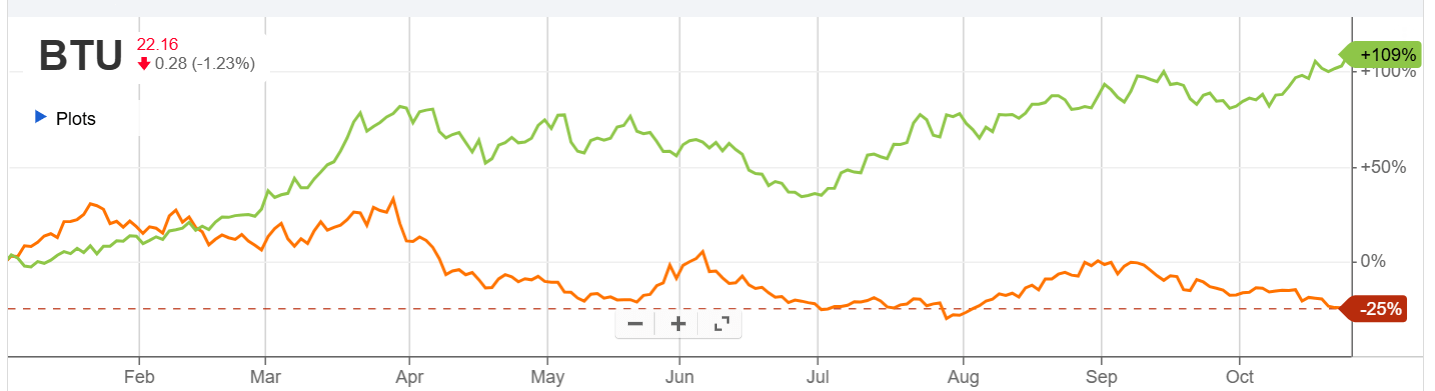
Peabody share price (red), versus Equinor (green) (Seeking Alpha.)
A number of factors, including commissioning costs at the Centurion project, played into this dynamic. However, I do expect Peabody's share price to eventually trade in correlation with a company like Equinor, as the coal market is likely to also correlate with European & Asian natural gas markets, where increasingly high prices make switching to coal for electricity generation more attractive.
Given the rising odds of a significant global demand destruction event due to rising energy prices, I expect to see Peabody's share price fall further from current levels. I see this as a buying opportunity, where I can continue incrementally increasing my position in this stock.
Risks to My Thesis
Because I am taking a cautious, incremental approach, the downside to my portfolio from this stock is very limited. If I increase it incrementally as it declines further, I will achieve a much lower average cost basis, which also helps to limit overall downside risk. There is also a risk of losing out in the event that Peabody's share price does not decline from here but rallies instead. If that is the case, I will have to be content with riding my current modest position on the way up.
Conclusions
The shorter-term dynamics of the company will most likely be driven by an improvement in internal factors as the Centurion project ramps up, while simultaneously, the company may see a worsening external situation, given an increasingly likely global economic slowdown. Looking beyond that, the internal improvements will persist, while the external factors will probably turn out better than expected. I therefore see Peabody as a potentially good long-term buying opportunity, with a buy window emerging over the winter, in expectation of better times ahead.
|








|