
 









|
Signature Sponsor


November 18, 2026 - Two seemingly contradictory things are happening in the world’s coal market right now. Consumption of the fuel is showing remarkable resilience. Across 193 of the 195 countries represented at this week’s COP31 climate conference in Antalya, Turkey, aggregate demand fell by about 10% between 2019 and 2025. That would be good news, if it weren’t for the two heavyweights: China and India, which together burn seven out of every 10 metric tons used globally. Their consumption rose by 13% and 28%, respectively, over the same period. Combined with policies that continue to favor coal, that has been enough to keep global demand bumping along at about 9 billion tons a year since 2023 — just when the world desperately needs a rapid and irreversible decline. Yet stubbornly high consumption doesn’t mean it’s a good time to be a coal miner. China and India have been able to cushion domestic generators and miners with capacity payments and favorable contract terms. Exporters have no such protection. With swaths of the industry losing money on every ton dug from the ground, the seaborne coal trade has become a Squid Game-style fight for survival. Turkey’s principal coal suppliers Russia and Colombia are ground zero. About 70% of Russian coal companies can’t make a profit and the industry is likely to lose 324 billion rubles ($3.9 billion) this year, the government estimated last month. Losses are expected to continue into a fourth consecutive year in 2027, even if prices improve. In the Kuznets basin, from where about half of Russia’s coal is extracted, 7,000 people lost their jobs last year and roughly a third of mining companies are shut or financially distressed.
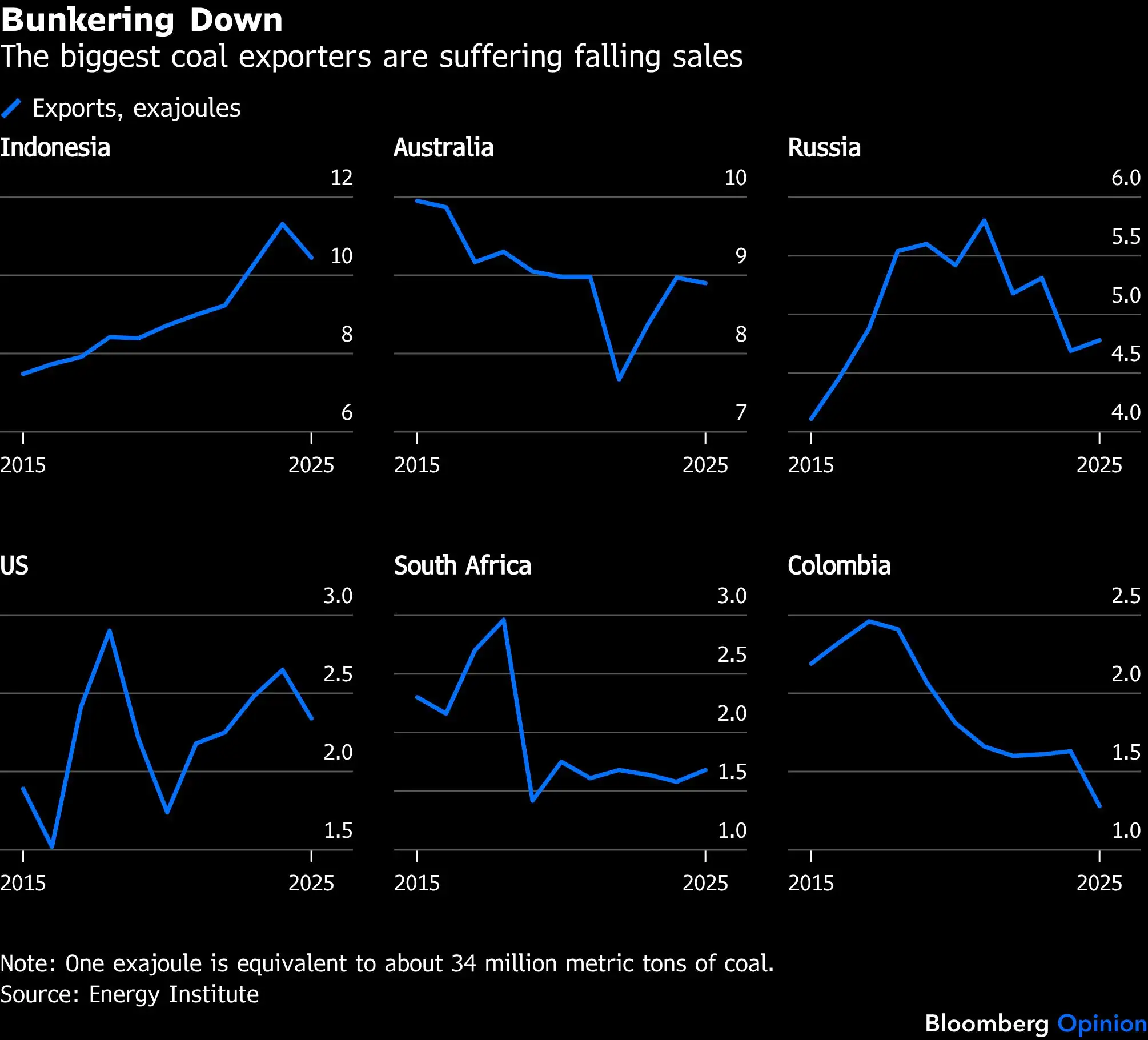
Colombia, whose mines helped power Europe through the 1990s and 2000s, is also feeling the squeeze. Exports fell by nearly a quarter in 2025, to their lowest level since 2003. Glencore Plc last year wrote $859 million off the value of Cerrejón — Latin America’s biggest coal mine, with a 5 billion-ton resource — and plans to hand it back to the government when its rights expire in 2034. South Africa, where export mines are barely making a profit these days, looks to be next in line. The fact that these operations are still running amid such bleak conditions is a clue to the brutal economics of a declining commodity. Miners don’t need demand to recover. They need their competitors to fold first. If enough Russian mines go under, the seaborne market will tighten, lifting prices and pushing loss-making operations in Colombia and South Africa back into the black. That should buy them some time before the next leg down in demand puts them in the firing line. For the US, Indonesia and Australia — the only other major players in the seaborne trade — what lies ahead looks less like a reprieve than a stay of execution. There’s a historical symmetry to this decline. Seaborne coal is being squeezed by the same remorseless economics that threaten the future of liquefied natural gas. Both industries took off in the aftermath of the 1970s oil shocks, when importers went searching for alternatives to dependence on Middle Eastern crude.
Coal and gas can be relatively cheap when consumed close to the source, especially when their pit-head price excludes the climate and health damage their pollution causes. Put them on a railway or a ship and transport them halfway around the world, however, and the economics deteriorate fast. Hefty transport costs leave them struggling to compete in energy markets where cheap, clean renewable power is relentlessly pushing prices lower. Consider those Siberian miners. For every $100 a Chinese utility pays for a metric ton of their coal, barely $25 makes it back to the pit. The rest pays for the astronomical cost of transporting the world’s dirtiest energy to a Pacific port and shipping it down the coast. It gets worse. To compete with the local cost of new wind and solar plants, the Chinese utility needs to be paying about $75 a ton. With transport costs largely unchanged, that would leave virtually nothing at the mine gate — wiping out the miner’s revenue, never mind its profits. That’s broadly the situation we’re seeing right now. Despite LNG shortages, policy support for fossil fuels, and government regulations to put a brake on wind and solar, Chinese fossil generation is declining in 2026 for the second year running. The coal industry once imagined a future of rising demand and healthy profits. Those days are long gone. What passes for good news these days is that consumption isn’t falling as fast as we need to avoid devastating climate change. That's an odd definition of success when you’re simultaneously shutting mines, laying off workers, losing money and writing down assets. The future of energy is local. Coal’s problem is that its mines aren’t. |








|