








|
Signature Sponsor


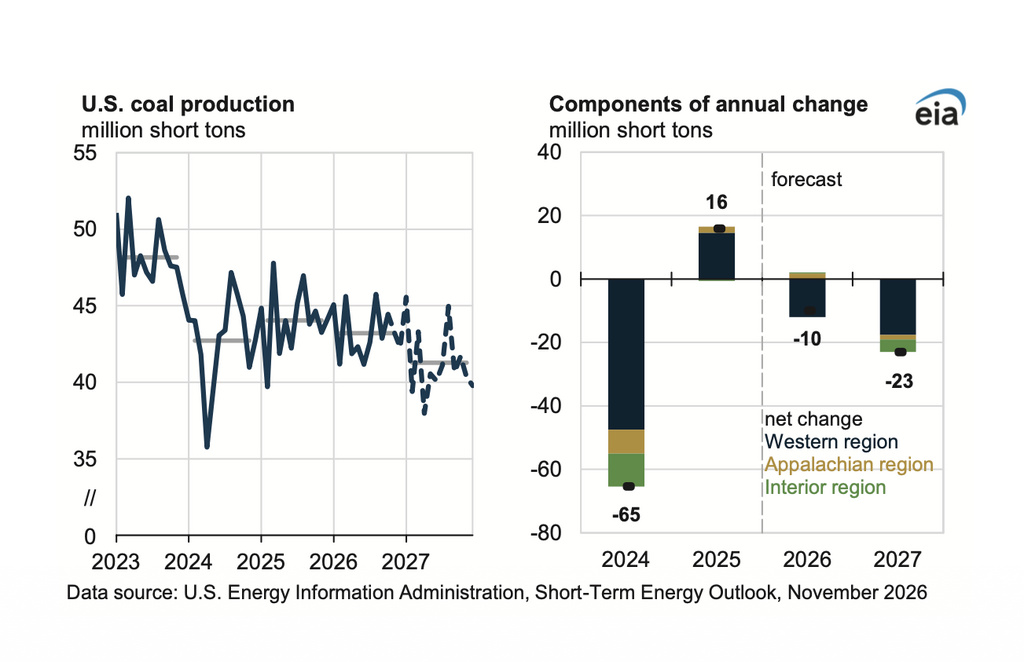
November 18, 2026 - U.S. coal production is expected to decline through 2027 as utilities burn less coal, although stronger exports should soften the impact on miners, according to the Energy Information Administration’s November 10 Short-Term Energy Outlook. EIA projects production of 518.5 million short tons in 2026, about 1.9% below last year and slightly lower than its previous forecast. Output is expected to fall another 4.5% in 2027 to 495.4 million short tons, a 3.6% reduction from the agency’s earlier estimate.
The outlook reflects a continuing drop in domestic coal consumption. EIA forecasts U.S. coal use of 419.2 million short tons in 2026, down about 7% from 2025, followed by a further decline to 398 million short tons in 2027. Export growth is expected to offset some of that lost demand, allowing production to fall more slowly than domestic consumption. Lower Gas Prices Pressure Coal Generation Electricity producers account for roughly 90% of U.S. coal consumption. Coal use at power plants was lower than a year earlier in eight of the first ten months of 2026, as additional wind and solar generation and cheaper natural gas reduced demand. Average natural gas prices paid by electricity generators fell about 9% during the second and third quarters, adding to the competitive pressure on coal. Power-sector coal consumption is projected to reach 384.4 million short tons in 2026, down approximately 7.5% from a year earlier. Coal use outside the power sector is also expected to decline. The pressure is expected to continue next year. EIA anticipates a 19% drop in natural gas prices for power plants in 2027, alongside further additions of wind and solar capacity. Together, those changes are expected to reduce total U.S. coal consumption by about 5%. Exports Offer Support U.S. coal exports are forecast to rise approximately 11.3% in 2026 to 103.2 million short tons. Metallurgical coal shipments are expected to increase about 7.8% to 53.8 million short tons, while thermal coal exports are projected to climb roughly 15.2% to 49.4 million short tons. Export volumes are expected to remain broadly steady in 2027, reaching 103.7 million short tons. Metallurgical coal shipments are forecast to edge up to 54.3 million short tons, with thermal coal exports holding at 49.4 million short tons. Asian demand and China’s commitment to purchase 10 million metric tonnes of U.S. coal in each of 2027 and 2028 are expected to support overseas sales. International markets remain an important outlet for U.S. producers facing weaker demand at home. Emissions Expected to Fall Before Edging Higher EIA forecasts U.S. energy-related carbon dioxide emissions of 4.84 billion metric tonnes in 2026, compared with 4.92 billion tonnes in 2025. Emissions are then expected to rise slightly to 4.86 billion tonnes in 2027. Lower coal consumption and reduced use of petroleum products account for much of the expected decline this year. Coal-related emissions are projected to fall again in 2027. However, increased natural gas consumption in commercial and industrial operations, together with greater use of distillate fuel oil, is expected to offset that reduction. For coal producers, the outlook points to continued competition from natural gas and renewable generation. Exports to Europe and Asia, including China’s purchase commitments, could provide a near-term buffer, but overseas sales are not expected to fully offset the decline in domestic demand. |








|