






|
Signature Sponsor


By Ken Ward, Jr.
November 9, 2015 - A safety program being touted by former Massey Energy CEO Don Blankenship’s defense attorneys was driven partly by concerns over what company officials felt was the skyrocketing cost of fines for federal violations and by fears that increased enforcement was blocking Massey from using extended cuts of coal the company relied on to keep production profitable, according to a newly released transcript of a major Massey safety meeting in 2009. Top Massey corporate leaders summoned hundreds of Massey mine managers, foremen and safety officers to the meeting at Scott High School on Aug. 1, 2009, to announce a goal of cutting the company’s U.S. Mine Safety and Health Administration violations in half as part of a new “hazard elimination program” that defense lawyers have said was conceived in part -- and strongly supported by -- Blankenship. “We’ve gotten ourselves in a situation where we’ll take a violation just to keep running coal,” then-Massey vice president and chief operating officer Chris Adkins said in opening the meeting, according to the transcript. “That’s the wrong mindset to have and it’s what we’re going to change today.” Adkins -- Blankenship’s right-hand man on mining operations issues -- was among the top Massey officials who spoke at the meeting. Blankenship did not attend. His lawyers have said that he was recovering from gallbladder surgery at the time. Judging from the transcript, the meeting was a mix of pep rally, mine safety briefing and corporate family reunion, with top Massey officials repeatedly pointing out familiar names and faces from the crowd and throwing in religious references and humor to try to make their points and keep the crowd engaged at a Saturday event. For example, Adkins discussed Massey’s development of mining clothing with reflective stripes and said the gear had benefits for workers beyond its safety advantages. “Think how many young guys wouldn’t have girlfriends right now if it weren’t for the reflective stripes,” Adkins said. “The guys laughing know about it, right? Because you can go to Walmart in stripes and you can pick up women. Because they don’t want to date somebody that ain’t got money and if you’re wearing stripes, they know you’re a coal miner. If you wear our color stripes, they know you work for Massey and they want to hook up. They’re great, in addition to the safety.” Gary Frampton, another Massey safety official, compared the need for company workers to know the safety rules to their need to read the Bible. “Well, here we have the little testament being the state law and to me you have this big testament, that’s this federal law,” Frampton said. “We got to dig into them and we got to know what these words are.” Adkins said that Massey had been spending $1.2 million per month on safety violations, money he said would be better spent “doing something else, doing something neat, safety interventions, adding more people to the payroll, opening up new coal mines, capital for new equipment.” But Elizabeth Chamberlin, who was then Massey’s vice president for safety, explained to those at the meeting that a series of mining disasters in 2006 -- including the deaths of two Massey miners in a belt fire at the Aracoma Mine -- prompted new pressure from government regulators, with new rules, a formula that increased safety fines, and more comprehensive inspections.
“We lost a lot of our deep cuts throughout the company and we are struggling now to get those deep cuts back,” Chamberlin said at the meeting. Late last week, Blankenship’s defense team publicly filed the meeting transcript with their latest motion asking to be able to play a video of the meeting for jurors in the trial in which Blankenship faces three felony charges, including an allegation that he conspired to violate federal mine safety standards and cover up the resulting hazards to mine workers. Berger has ruled out two versions of the video -- neither which has been made public in the case file -- calling the meeting speeches “puffery” that were “riddled with hearsay that are inadmissible.” The meeting was the kickoff event for Massey’s self-described program to reduce mining hazards and curb growing safety violations. Whether the program was an honest effort to meet those goals, as defense lawyers say, or just propaganda, as prosecutors argue, is shaping up to be one of the central issues as the trial prepares to enter its 22nd day on Monday. During testimony last week, jurors heard former Massey ventilation expert Bill Ross -- a major prosecution witness -- testify about some of the things that he heard when he attended the meeting. For example, on cross-examination by lead defense lawyer Bill Taylor, Ross agreed with Taylor that Adkins said “I’m not winking. I’m not nodding” when he told Massey mine managers not to start coal production if safety problems weren’t first corrected. Questioned on re-direct examination by Assistant U.S. Attorney Steve Ruby, Ross said that he didn’t hear anyone at the meeting say that Massey was going to hire more workers to help keep up with safety regulations. According to the meeting transcript, speakers went through fairly lengthy lists giving examples of specific safety hazards that Massey workers needed to pay more attention to and ensure were corrected. “We’re going to reduce our hazards at our coal mines,” Adkins said at the meeting. “We’re going to leave this room today with a whole new attitude. We’re not going to have the hazards. We’re going to see them, we’re going to eliminate them immediately. We’re not going to wait.” While Adkins said Massey had set a goal of reducing violations by 50 percent, he also said at the meeting that MSHA District Manager Bob Hardman had told company officials he thought that a better goal would be 60 percent to 70 percent. “Now, this is the district manager of West Virginia for MSHA telling Massey that he thinks we’re getting 60 to 70 percent more violations than we should get,” Adkins said. “And I’m thinking, you know, he doesn’t think we’re very good.” Adkins reminded the crowd that Massey employees all had families who wanted their loved ones to come home every day safe and healthy. “I got one that’s 8,” Adkins said. “Waits for me every day. Wants to pass ball every day you get home. That’s why you do it. That’s why you take care of the people, right?” Adkins recalled how Massey developed technology to protect bulldozer operators after a worker he knew died when a coal stockpile collapsed, burying his dozer. Adkins got the phone call about that incident while he was at McDonald’s, where his daughter was playing in the ball pit. “And I couldn’t get her out of the ball thing,” Adkins recalled. “She wouldn’t come down. She was about that tall. And we had to climb up in there and chase her through all them tubes to get her out and then get over there and find out we can’t talk to Zeke. We dig him out and he’s dead.” Chamberlin told the crowd that she compared Massey’s number of safety violations to other major coal producers, including Arch Coal, Peabody Energy, Alliance Coal and CONSOL Energy. “We’re an embarrassment in terms of the number of violations that we get as compared to what they do, the tonnages we mine,” Chamberlin said. “I know we can do better.” Chamberlin, though, said that “a new penalty scheme” put in place after the 2006 disasters “took violations ... and made them 10 to 20 or maybe 30 times more than they had been prior to the new penalty regulations.” Chamberlin said that Massey got into problems with violations partly because of “a decision that was made before I came to Massey and I think it was a good decision at the time, but ultimately I think it was fatally flawed which is we elected to turn over a large share of our violations management to an outside law firm to manage and to make a lot of decisions for us and to challenge the lion’s share of violations that were issued to the company. “Couple of problems with that is the attorneys have it in their own best interest for us to continue to generate violations because that their livelihood, right?” Chamberlin said. “So in a sense it was kind of like inviting the fox to live in your hen house.” Chamberlin added, “But the other thing is it sent a message to the agencies that in our viewpoint we didn’t care to hear what they had to say about violations being issued at our coal mines because we were doing, we were challenging the majority of them.” “And I also think that we sent a message to our people that it wasn’t as important to eliminate the violations that were being cited because they were violations rather than being hazards,” Chamberlin said. “And that’s the mindset that we need to get over as we move forward here with this hazard elimination program. “This is a paradigm shift for us,” Chamberlin said. “This is like going from white to black right? But this is a program that we need to put in place and that we need to make sustainable.” Adkins said that Massey was going to focus on tracking violations to the individuals who created them and getting that sort of behavior to stop, comparing the plan to dealing with his children.
Adkins also compared efforts to improve Massey to how he said Walt Disney decided to draw Mickey Mouse with four fingers. “Walt Disney was smart,” Adkins said. “Walt Disney had to hand-draw every digit and every time you make a cartoon move you had to draw thousands of renditions of the same character barely moving those things. And he knew that if he drew one less digit on that hand, he could draw faster. “Because like the 4.2 million times that we’re hauling shuttle cars, he knew if he had to draw it 4.2 million times that he was going to draw it as quick as he could,” Adkins said. “So Walt Disney knew four fingers, I can draw it quicker. I can get my pictures quicker and therefore my cartoon turned out quicker.”
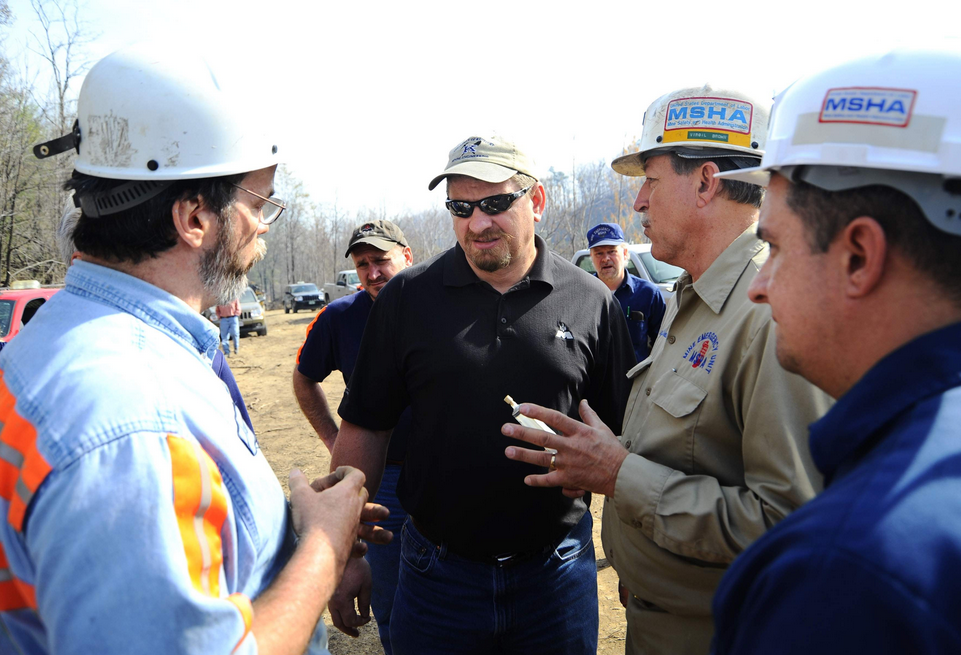
Then-Massey Energy chief operating officer Chris Adkins, second from left, talks to MSHA officials during the rescue operations following the April 2010 explosion at the Upper Big Branch Mine. - See more at: http://www.wvgazettemail.com/article/20151108/GZ15/151109511/1125#sthash.FM1a7KsV.dpuf
Then-Massey Energy chief operating officer Chris Adkins, second from left, talks to MSHA officials during the rescue operations following the April 2010 explosion at the Upper Big Branch Mine.
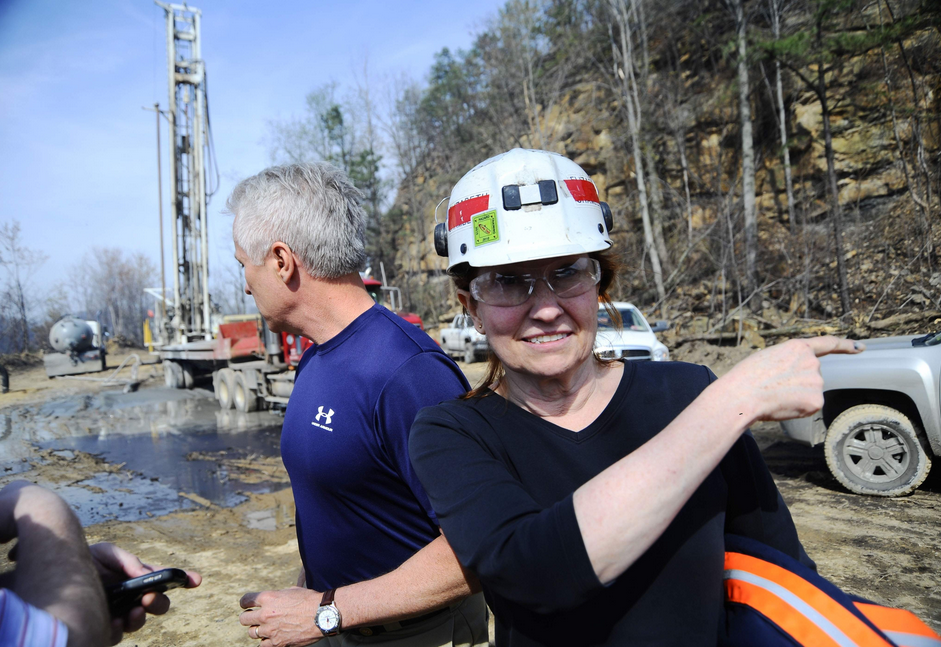
Then-Massey Energy safety official Elizabeth Chamberlin talks to a reporter during the rescue operations following the Upper Big Branch Mine Disaster. |






|